Is Bioluminescent Algae Harmful To Humans?
A plain safety answer on whether the bioluminescent organisms in Puerto Rico's bays can hurt you, what the toxin science actually says, and where swimming is allowed.
Is Bioluminescent Algae Harmful To Humans?
No. The glow in Puerto Rico's bays comes from a dinoflagellate called Pyrodinium bahamense, and no harm to humans from skin contact or water exposure has been documented in these waters. A 2024 study in the journal Marine Drugs measured an extremely low saxitoxin quota in a Mosquito Bay sample, and the saxitoxin concerns that exist elsewhere relate to eating contaminated shellfish, not to paddling, wading or swimming among the organisms.
That is the plain answer, and it comes with an honest footnote. The species found in Puerto Rico's bays has a close relative in Florida's Indian River Lagoon that is studied for its toxin production, so scientists do test Caribbean populations. The 2024 analysis found that Mosquito Bay's Pyrodinium bahamense carries a substantially lower frequency of the gene key for saxitoxin synthesis than the Florida populations, and a July 2022 sample from the bay showed an average saxitoxin quota of just 0.3 picograms per cell. The researchers' working assumption is that the Puerto Rico bay populations are non-toxic, with no reported toxicity in the islands.
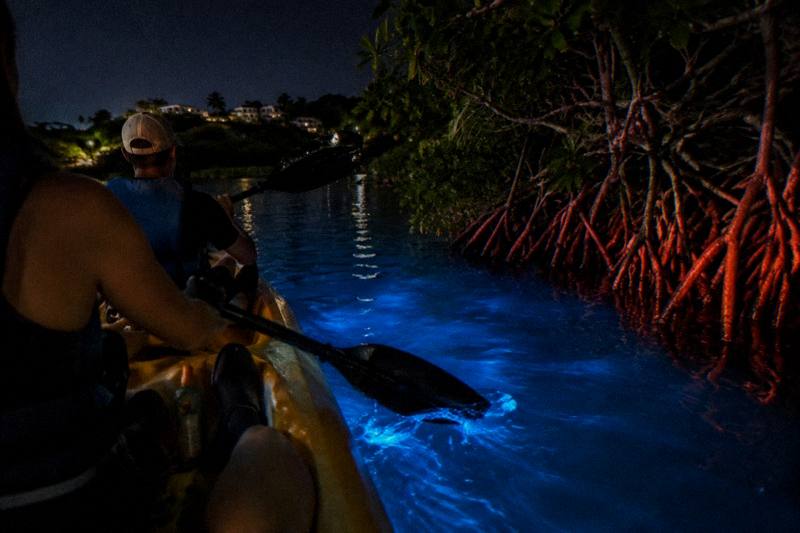
The word "algae" deserves a quick correction, because it changes how the question reads. The glow is not produced by algae in the seaweed sense, and it is definitely not the sargassum that has washed up on Puerto Rico's coasts in record volumes, a projected 55 million tons across the region in 2026. It is produced by microscopic single-celled dinoflagellates, plankton that flash blue when the water around them is agitated. Your paddle stroke, a fish darting past, or the wake of a boat triggers the light. That flash is a defense reflex, not an attack, and it has no mechanism for hurting you.
What actually matters for visitor safety is not the organism but the rules around it. Swimming is not permitted at Mosquito Bay on Vieques or at Laguna Grande in Fajardo, and that ban exists to protect the dinoflagellates, not to protect you from them. La Parguera in Lajas is the only one of the three bays where swimming in the glowing water is generally permitted on most nights, subject to each operator's own safety rules. The rest of this article walks through the science, the bay-by-bay rules and the practical safety picture on the water. If the chance to swim in the glow is what draws you to Lajas, our guide to whether La Parguera's bay justifies the trip weighs that experience against the bays in Fajardo and Vieques.
What Does The Science Say About Pyrodinium Bahamense Toxins?
The research on Mosquito Bay, published in Marine Drugs in 2024, found the dinoflagellate populations there carry a much lower frequency of the saxitoxin-producing genotype than Florida populations, and measured only 0.3 picograms of saxitoxin per cell in a 2022 sample. For the Puerto Rico bays the conclusion is non-toxic, with no documented illness from water exposure or skin contact.
Saxitoxin is a real thing and worth understanding, because it is the reason anyone asks this question at all. In some parts of the world, Pyrodinium bahamense is a classic cause of paralytic shellfish poisoning: the plankton bloom, shellfish filter them from the water, and people who eat those shellfish can be poisoned. That chain of events requires ingestion of contaminated seafood. It does not happen through the skin, and it does not happen from swimming in water that contains the organisms. The 2024 analysis of Mosquito Bay, which you can read at the study page in Marine Drugs, treats the Puerto Rico populations as effectively harmless to visitors.
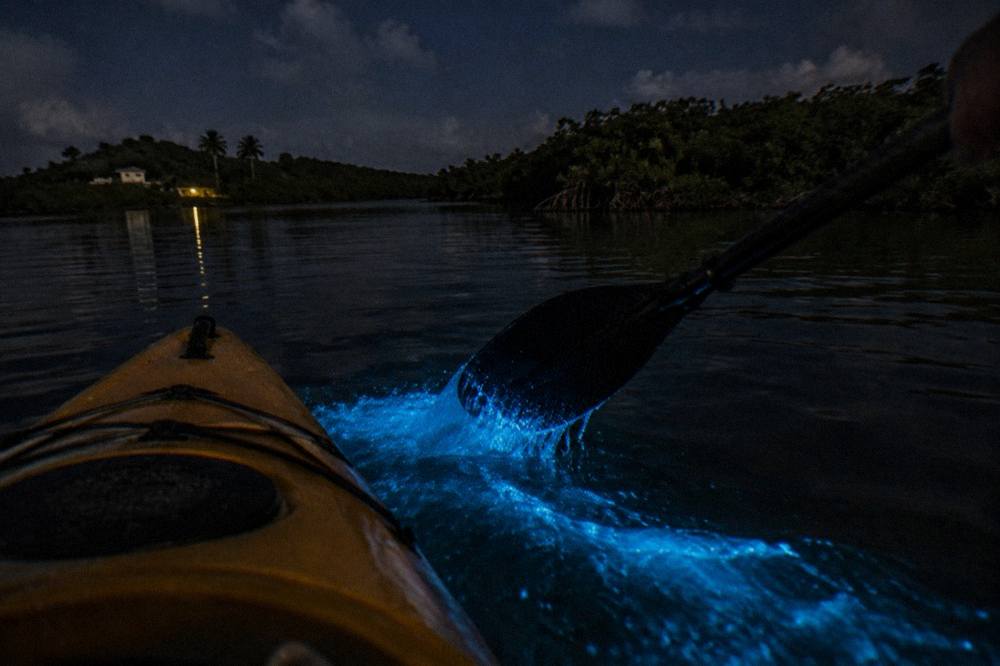
The bay itself is also one of the most closely monitored bodies of water in the Caribbean. Mosquito Bay holds the Guinness World Record for the brightest bioluminescent bay, with up to 700,000 dinoflagellates per gallon recognised in 2006, and it sits inside a protected natural reserve co-managed by the Vieques Conservation and Historical Trust and the DRNA. The Trust runs continuous plankton abundance counts and water-quality monitoring; during a June 2026 site visit, biologists measured 304,000 organisms per gallon. A bay that is watched this closely is not a bay where a hidden health hazard would go unnoticed.
One reason the concentration runs so high, and a piece of information gain most first-page travel articles skip: water in Mosquito Bay stays in the bay about 13.5 to 14.5 days before flushing out. That long residence time is exactly what lets the population build to record densities, because faster-flushing bays simply cannot hold the same concentration. Swimming is not permitted at these bays to protect the fragile dinoflagellates, a point covered in the next section.
There is also an active restoration story at Mosquito Bay that speaks to how seriously the ecosystem is guarded. A NOAA-funded project of about $2.96 million, begun in December 2024 with the Vieques Conservation and Historical Trust and DRNA, is rebuilding mangroves, seagrass and coral around the reserve; by September 2026 it reported an 84 percent mangrove planting success rate from a nursery of close to 4,000 plants. The mangroves at the bay mouth protect the bloom from washing out after Hurricane Maria nearly wiped them out, so keeping the water clean is treated as a conservation matter of the first order.
Can You Swim In The Bioluminescent Bays In Puerto Rico?
At two of the three bays, no. Swimming is not permitted at Mosquito Bay on Vieques or at Laguna Grande in Fajardo, a DRNA-enforced rule that exists to protect the dinoflagellates. La Parguera in Lajas is the only one of the three where swimming in the glowing water is generally permitted, on most nights, with flotation required and operators setting their own safety rules.
The distinction matters enough to repeat plainly: the no-swimming rule at Mosquito Bay and Laguna Grande is not a health warning about the water. It is the reverse. The official guidance from Discover Puerto Rico's page on protecting the bioluminescent bays explains that the ban protects the bay's fragile dinoflagellates. You are the risk to the bay, in other words, not the other way round. Laguna Grande sits inside the Cabezas de San Juan Natural Reserve, and Mosquito Bay is protected as the Vieques Bioluminescent Bay Natural Reserve, so both carry conservation-grade rules.
| Bay | Location | Swimming | Night formats |
|---|---|---|---|
| Laguna Grande | Fajardo (Las Croabas) | Not permitted | Kayak and tandem kayak tours only |
| Mosquito Bay | Vieques (Esperanza departures) | Not permitted | Kayak, clear kayak, canoe, pontoon and electric boat tours |
| La Parguera | Lajas | Generally permitted on most nights | The only bay where motorboat tours run at night |
La Parguera is the exception, and the reason our related tour for this article lives there. Swimming in the glowing water is generally permitted at La Parguera on most nights, though it is not guaranteed every night, and operators set their own requirements: flotation is required, and touching the organisms is not allowed even where swimming is. The Mareaito Charters sunset and bio bay cruise pairs a sunset swim stop at the Caracoles sandbar with the bay visit, and it earns a 4.8 rating from 573 reviews. You can read more in the site's La Parguera bay guide or on the can you swim in the bio bay page.
If your heart is set on Fajardo rather than Lajas, the honest answer is that you will still be on the water, just not in it. The featured Fajardo listing on this site, the Bio Bay Kayak Tour run by Kayaking Puerto Rico, is a guided tandem kayak outing through the mangrove channel into Laguna Grande, about 2 hours, from $89 per person, rated 4.7 from 2,176 reviews, with eco-friendly insect repellent and light snacks on the inclusion list. Paddling agitates the water, which is exactly what makes the glow appear around your boat, so the no-swimming rule costs you nothing in spectacle.
What Are The Rules On The Water At Night?
The rules that actually affect your safety and comfort are about light and noise: use eco-friendly insect repellent, preferably a cream or balm applied at least 30 minutes before the tour, avoid flashlights and phone screens that destroy night vision, keep noise down, and do not touch or remove anything from the water. At La Parguera, flotation is required for swimming. These rules apply at all three bays and are the practical core of responsible visiting. If you would rather skip a guided outing, our guide to visiting the bays without a tour explains which bays allow independent visits and which ones make a licensed guide the easier route.
The repellent timing is not fussiness. Swimming is not permitted at the other two bays in order to protect the fragile dinoflagellates, so a balm or cream applied half an hour before you launch has time to absorb. The listing for the Fajardo kayak tour actually includes eco-friendly insect repellent in its inclusions, which tells you how standard this practice is among operators. Lotions and sunscreen: put them on well before you go, and follow your guide's instructions on the night.
| Rule | Where it applies | Why |
|---|---|---|
| No swimming | Laguna Grande, Mosquito Bay | Protects the bay's fragile dinoflagellates from disturbance |
| Swimming with flotation only | La Parguera, most nights | Operator safety requirement; night water, no exceptions |
| No touching organisms | All three bays | Physical disturbance harms the population |
| Eco-friendly repellent as balm, 30 minutes before | All three bays | Keeps spray residue off the water |
| No flashlights or phone screens on the water | All three bays | Protects night vision needed to see the glow |
| Motorboats at night | La Parguera only | The other two bays are kayak and electric or pontoon formats only |
Light discipline is the rule visitors break most often, usually by checking a phone. Bright artificial light destroys the dark adaptation your eyes need to see the bioluminescence at all, and standard phone cameras struggle badly to capture the glow, so the screen time costs you the experience and produces a disappointing photo anyway. The conservation guidance is blunt: avoid flashlights, phone screens and any unnecessary light. Some guides on bright nights take active measures; one Fajardo listing notes that guides may use a tarp to block moonlight, which gives you a sense of how seriously operators manage the viewing conditions.
One moon rule is written into regulation rather than operator preference. DRNA-licensed operators may not run Mosquito Bay tours the night before, the night of, and the night after a full moon, three nights per lunar cycle when the moonlight drowns the glow. That restriction is specific to Mosquito Bay. At Fajardo, one operator, Puerto Rico Bio Bay Tours LLC, sells the moonlit window as a feature, a full moon kayak tour through the mangrove channels, listed at about 3 hours from $85 per person with a 4.6 rating from 274 reviews. Planning around the lunar calendar matters more than any health worry, and the site's moon phase guide covers it in detail.
Can The Water Itself Make You Sick?
No illness has been documented from water exposure in these bays, and the scientific literature treats the Puerto Rico Pyrodinium populations as non-toxic to people in the water. The realistic discomforts of a bio bay night are ordinary ones: insects in the mangroves, saltwater in the eyes, a wet seat in a tandem kayak, and the normal risks of night paddling or being on a small boat, which is what the life jackets and the guides are for.
It helps to separate the bay water from the surrounding environment. The organisms are harmless; the mangrove channels you paddle through are wild nighttime habitat, and insects are the classic nuisance. That is why repellent is standard issue, why one Fajardo operator lists eco-friendly repellent as an inclusion, and why this site keeps a practical answer to whether Mosquito Bay has a lot of mosquitoes. None of that is toxicity. It is a tropical night on the water.
Environmental events do affect the bays, but again not in a way that harms visitors. In July 2026, sargassum covered about 80 cuerdas of La Parguera bay and the DRNA activated its removal protocol, and heavy rainfall can temporarily reduce dinoflagellate concentrations and cloud the water, lowering the visible glow. Those are ecology and visibility stories. The DRNA's 2026 integrated water-quality report includes dedicated monitoring segments for both Bahía Mosquito and Bahía Bioluminiscente La Parguera, so the water is tracked officially and continuously.
The honest caveat, because this site does not promise glow: bioluminescence is wild and varies with moon, rain, season and water conditions. The organisms are present year-round, but the visible intensity varies, and a dim night is possible at any of the three bays. No operator can guarantee brightness, and a page that does is selling you something the bay cannot promise. Choose your night by the lunar calendar, go with a licensed operator, and treat the glow as the extraordinary natural event it is rather than a scheduled show.
Which Tour Format Is Safest For Nervous Swimmers?
Every listing on this site runs with a guide, and the formats split cleanly by comfort level: tandem kayaks at Fajardo, small clear kayaks and canoes at Vieques, and boat-based options including a 24 foot pontoon and a 24 foot electric catamaran where you stay aboard. For anyone uneasy about paddling at night, the boat formats remove the paddling entirely, and La Parguera's cruises let you decide on the night whether to get in the water.
The La Parguera boat fleet is the natural starting point. The Isla Nena pontoon at Mosquito Bay, a 24 foot boat carrying up to 9 travellers for about 40 minutes on the bay from $85 per person, rated 4.4 from 262 reviews, keeps you dry and seated. At La Parguera itself, the Joytourspr boat tour runs about 1 hour from $75 per person with up to 6 participants, and the Borikua electric catamaran carries up to 9 for about 40 minutes from $105 per person. The listing for the Joytourspr boat states plainly that it is not a kayak tour and there is no bathroom, the kind of operational detail worth knowing before you book.
| Format | Bay | Example listing | Group size | From price |
|---|---|---|---|---|
| Tandem kayak | Laguna Grande | Kayaking Puerto Rico, 2 hours | Up to 30 | $89 per person |
| Guided kayak | Mosquito Bay | Vieques Kayaks Bio Bay, 2 hours | Up to 14 | $65 per person |
| Clear kayak | Mosquito Bay | Alikei Adventures, 1 hour 30 | Up to 12 | $60 per person |
| Clear canoe | Mosquito Bay | Adventure Vieques, 1 hour 30 | Up to 20 | $57 per person |
| Pontoon boat | Mosquito Bay | Isla Nena, about 40 minutes | Up to 9 | $85 per person |
| Boat and swim | La Parguera | Mareaito Charters, 2 hours | Boat group | $65 per person |
On Vieques, where you must already be on the island, the choices range from the traditional guided kayak, the Vieques Kayaks Bio Bay trip from $65 per person rated 4.5 from 1,242 reviews, to the clear kayak and canoe formats that add a window onto the water below you. The Alikei Adventures clear kayak outing, rated 4.8 from 491 reviews from $60 per person, includes the van ride to the bay from the Esperanza meeting point. Every one of these is a guided group with an operator licensed for that bay, and every listing on this roster carries free cancellation up to 24 hours before, which removes most of the planning risk.
If getting to the bay is the harder part, the transfer listings from San Juan solve it, from the Bio Bay Night Kayaking with Transport run by Puerto Rico Access Eco Tours at from $125 per person, to the twelve hour El Yunque and bio bay combinations that stack a rainforest hike onto the day. A full safety picture for families is on the bio bay with kids page, and the kayak tour guide collects the age and weight rules listing by listing, kayak weight limits from 225 to about 260 lb and minimum ages from 5 to 8 years.
The site's own Bioluminescent Bay Tours Puerto Rico comparison pages break all 24 listings down by bay, price and format if you want the full roster rather than the safety shortlist here.
Common Questions About Bioluminescent Algae Safety
Is bioluminescent algae harmful to humans?
No. In Puerto Rico's bays the organism is a dinoflagellate, Pyrodinium bahamense, reported non-toxic in these waters. A 2024 study measured an extremely low saxitoxin quota in a Mosquito Bay sample, and the documented saxitoxin risks elsewhere involve eating contaminated shellfish, not skin contact or swimming.
Can the glow cause a rash or skin reaction?
No skin reaction from the organisms has been documented in Puerto Rico's bays. The reported irritations after tours trace to ordinary causes: saltwater, chafing from a kayak seat, or insect bites in the mangroves. Eco-friendly repellent applied before the tour handles the most common nuisance.
Can you swim in the bioluminescent bays?
Not at Mosquito Bay or Laguna Grande, where swimming is prohibited to protect the dinoflagellates. La Parguera is the only one of the three where swimming is generally permitted on most nights, with flotation required and operators setting their own rules.
Is it safe to touch the bioluminescent water?
Paddling, splashing and swimming where permitted agitate the water and are how the glow appears, but the responsible-visit guidance is to not touch or remove anything from the water. At La Parguera, no touching organisms is an operator rule even on swim nights.
Is bioluminescent algae harmful to dogs or kids?
The organisms are reported non-toxic, and listings set their own rules: the Fajardo kayak listings state a 6 year minimum age and weight limits from 225 to 245 lb per person. For anything beyond that, including pets, check the individual listing, since policies vary by operator.
Does the full moon make the bay unsafe?
No, it makes the glow harder to see. Mosquito Bay tours may not run the night before, of and after a full moon under DRNA rules, and dark new-moon nights give the best viewing at all three bays.