Does Mosquito Bay Have A Lot Of Mosquitoes?
The honest answer on insects at Mosquito Bay in Vieques, what to bring, how repellent rules protect the bay, and which evening tours visit it.
Mosquito Bay in Vieques holds the Guinness World Record for the brightest bioluminescent bay on Earth, with up to 700,000 dinoflagellates per gallon measured in its water. The name invites an obvious question, and it is a fair one to ask before you commit to two hours on warm tropical water after dark. The honest answer has less to do with any census of insects and more to do with mangroves, humidity, and the rules every visitor is asked to follow to keep the bay glowing. This page works through what is actually verified about evenings at the bay, what the name does and does not tell you, and how the tours that visit it handle the practical side of bugs and repellent.
Does Mosquito Bay Have A Lot Of Mosquitoes?
No verified source confirms whether Mosquito Bay has a lot of mosquitoes. None quantify how many are present on a given evening, and no tour listing or official page states biting levels, so the only reliable detail is that the count is unrecorded, and any specific claim about mosquito numbers there would be invented. What is verified is simpler: Mosquito Bay sits inside a mangrove reserve in tropical Vieques, mangroves and warm humid nights are classic insect habitat anywhere in the Caribbean, and the official responsible-visitor guidance for all three Puerto Rico bio bays tells visitors to wear eco-friendly insect repellent. Treat insects as a normal possibility on any tropical evening near mangroves and prepare accordingly, rather than expecting either a plague or a bug-free night.
The instruction to use repellent is not a hint that the bay is unusually infested. Discover Puerto Rico, the island's official tourism body, publishes the same responsible-visit guidance for all three bioluminescent bays: Laguna Grande in Fajardo, Mosquito Bay in Vieques and La Parguera in Lajas. Insects are simply part of the environment at every one of them, and the guidance exists as much to protect the water as to protect you, a point this page returns to below.
That is worth stating plainly, because plenty of travel copy hedges or jokes about the name and leaves readers no better informed. The one thing the verified sources do not support is an origin story for the name. No official page fetched for this site explains the etymology, so this article will not invent one. What can be said from evidence is that a bay ringed by mangroves in a humid tropical climate will have insects on some evenings, and that every licensed operator plans for that.
Preparation is cheap and effective. The verified guidance is specific: eco-friendly repellent, in cream or balm form rather than spray, applied at least 30 minutes before the tour. The 30-minute window matters because it gives the product time to bind to skin rather than the water, and the cream-over-spray preference matters because aerosol droplets drift onto the water surface, which is the one thing the bay cannot afford. Visitors are also asked not to touch the water after applying repellent, since these products can harm the dinoflagellates that produce the glow.
If you are weighing a visit, the practical choice of tour matters as much as the packing list. The Vieques Kayaks Bio Bay kayak trip is the most-reviewed way onto the water, and the clear kayak and pontoon formats offer alternatives.
Why The Verified Repellent Guidance Exists
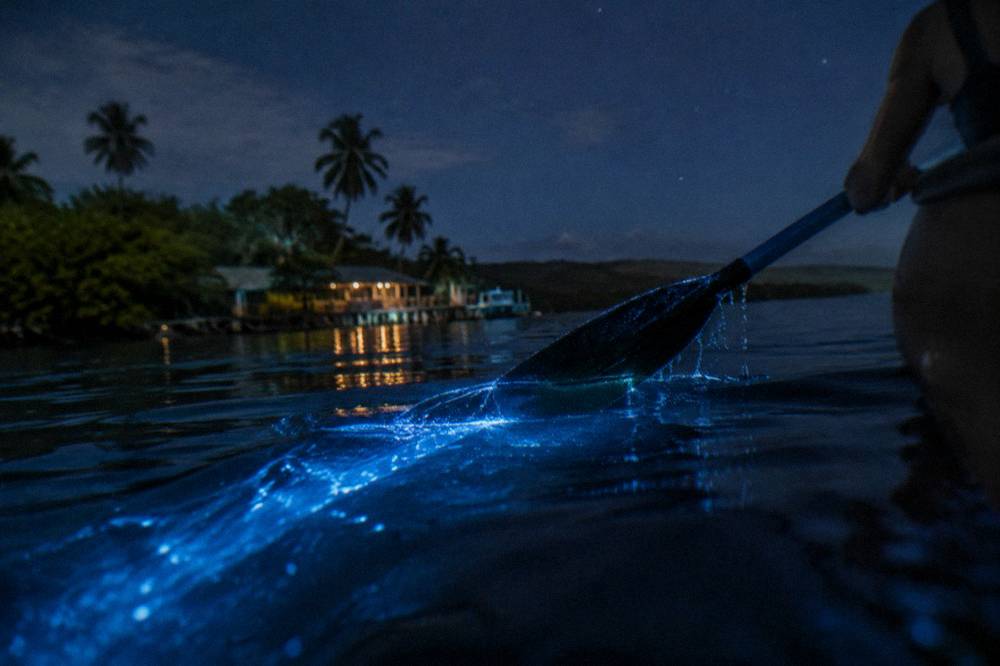
The repellent guidance exists because chemicals and sprays can wash off swimmers and harm Pyrodinium bahamense, the bioluminescent dinoflagellate responsible for the bay's blue glow. Protecting that fragile organism keeps the glow bright and the ecosystem intact, so Mosquito Bay asks visitors to follow specific repellent rules before entering the water. The no-swimming rule, the no-touching rule and the repellent rule all serve the same purpose: keeping the dinoflagellate population healthy in the small, sheltered bay that depends on it.
The stakes are real and well documented. The Vieques Conservation and Historical Trust, which co-manages the reserve with the Department of Natural and Environmental Resources, notes that Hurricane Maria's storm surge caused almost total mortality of the mangroves at the mouth of Puerto Mosquito, the trees that shelter the bloom from washing out, and that natural recovery of that protective shape can take 15 to 30 years. A NOAA-funded restoration of about $2.96 million began in December 2024 to rebuild that buffer, with a nursery of close to 4,000 plants and 84 percent planting success reported. Against that scale of effort, the ask that visitors arrive with repellent already absorbed into skin rather than fresh on its surface is small.
The water itself is part of the reason the rules are strict. Mosquito Bay's water stays in the lagoon about 13.5 to 14.5 days before exchanging, a slow residence time that lets the dinoflagellate population build to record densities. The trade-off is that swimming is not permitted here, a rule that protects the bay's fragile dinoflagellates. Faster-flushing bays cannot hold a bloom like this one, which is exactly why this bay glows the way it does and why the protection rules are written the way they are.
For visitors, this is where the packing question becomes practical rather than philosophical. The rules below are the verified responsible-visit guidance for all three Puerto Rico bio bays, and they double as the best answer to the insect question: they assume bugs may be present and give you a bay-safe way to deal with them.
| Guidance | What it means in practice |
|---|---|
| Use eco-friendly insect repellent | Choose a product labeled eco-friendly; conventional formulas can harm dinoflagellates if they wash off |
| Creams or balms, not sprays | Aerosol droplets drift onto the water surface; creams bind to skin |
| Apply at least 30 minutes before the tour | Gives the product time to absorb so less sits on the skin surface |
| Do not touch the water after applying | Keeps residue out of the lagoon's slow-exchanging water |
| Keep noise and light down | Protects night vision and the experience; flashlights and phone screens are discouraged |
One tour on the Fajardo side of the island makes the repellent point explicit in its own listing facts: the featured Fajardo kayak tour lists eco-friendly insect repellent among its inclusions, which tells you operators treat this as a standard part of the evening rather than an afterthought. For Vieques listings, check the listing for what the operator supplies.
What Evenings At Mosquito Bay Are Actually Like
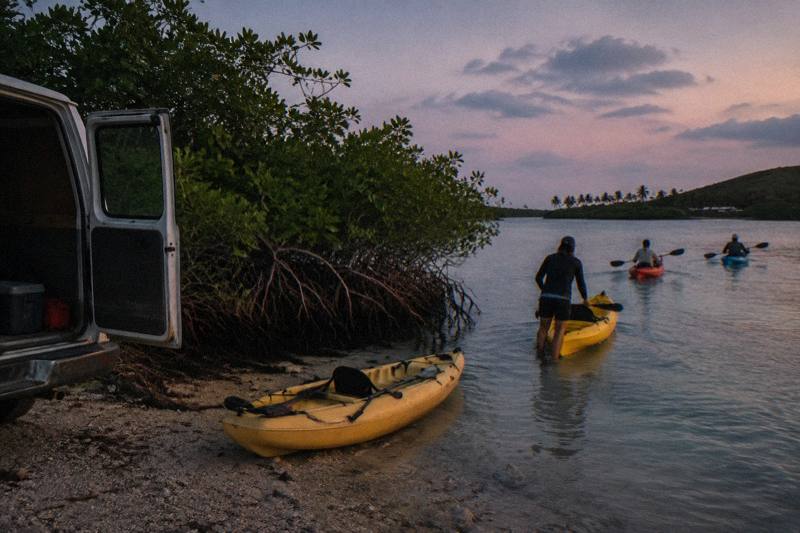
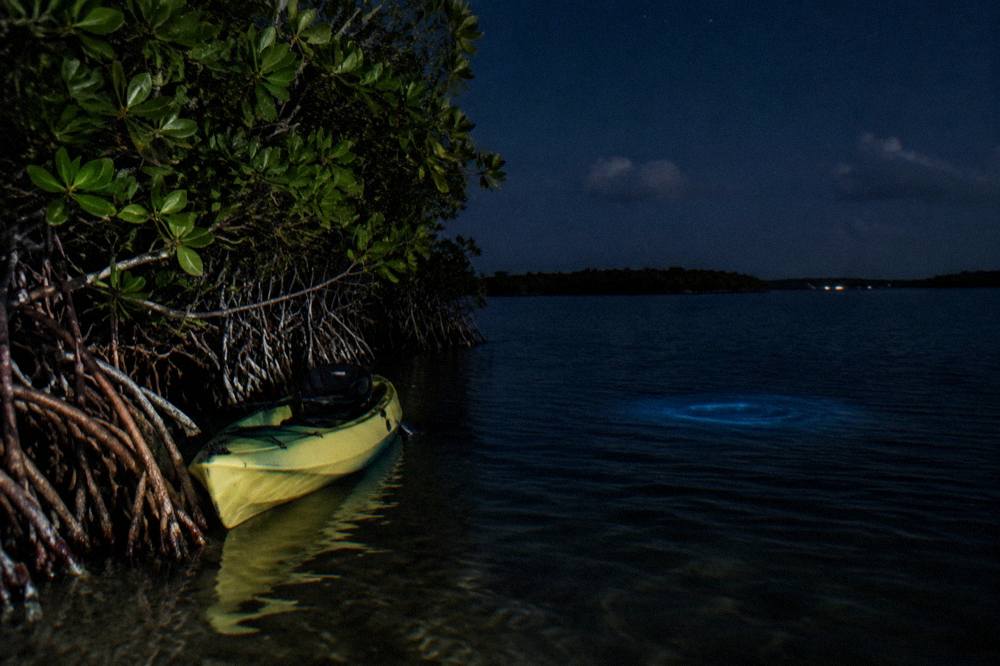
Evenings at Mosquito Bay are warm, dark, and surprisingly quiet: licensed operators launch from the Esperanza side of Vieques after sunset, then paddle or motor you into the bay with lights kept low so your eyes can adjust to the water's famous glow. The experience feels more like a slow drift through starlight than a high-energy tour, with guides pausing often so you can watch the bay shimmer around you. The bay is reached through a mangrove-lined entrance, the same trees the restoration project is rebuilding, and the whole experience is built around protecting night vision. Flashlights, phone screens and any unnecessary light are discouraged on the water.
The format you choose shapes the evening. The Vieques Kayaks Bio Bay kayak trip runs about 2 hours from $65 per person with a 4.5 rating from 1,242 reviews, carries up to 14 travellers, and includes round trip transport from the Calle Flamboyan meeting point to the bay entrance. Alikei Adventures runs a clear kayak version, from $60 per person, 1 hour 30 minutes, with a 4.8 rating from 491 reviews. Adventure Vieques offers full clear canoes from $57 per person where the water is visible around and below you. On the boat side, Isla Nena Bio Bay Boat Tours takes up to 9 guests out on a 24 foot pontoon for about 40 minutes from $85 per person, and Borikua Tours runs a 24 foot electric catamaran over the same water from $105 per person.
Vieques tours on this site assume you are already on the island. Mosquito Bay tours run at night, and the general guidance for visiting the bay is that an overnight stay on Vieques is recommended rather than a same-day dash back to the main island. The only San Juan departure that includes the Ceiba to Vieques ferry is the I VENTURES ferry day trip, an 11 hour day from $230 per person.
Whatever the format, remember the two standing rules that distinguish Mosquito Bay from La Parguera: no swimming, and no gas motorboats. Swimming has been prohibited at Mosquito Bay since shortly after a 2014 blackout in the bay's glow, when the restriction was introduced to protect the organisms. If swimming in glowing water is what you are after, that experience belongs to La Parguera, a distinction covered in the guide to swimming at Puerto Rico's bio bays.
How The Three Bays Compare On Rules And Bugs
The responsible-visit guidance, including the rules about bug repellent, is identical at all three Puerto Rico bio bays. What differs is what you can do on the water: only La Parguera permits swimming and motorboats at night, so the other two bays do not allow those activities after dark. Insect guidance does not change by bay. If you are choosing between destinations partly on the bug question, there is no verified basis for ranking one bay above another, only on what kind of tour you want.
| Bay | Location and access | Night formats | Swimming |
|---|---|---|---|
| Mosquito Bay | Vieques, reached from Esperanza; ferry or flight to the island | Kayak, clear kayak, full clear canoe, pontoon boat, electric catamaran | Not permitted |
| Laguna Grande | Fajardo, about 1 to 1.25 hours by car from San Juan | Guided kayak only, launching from Las Croabas | Not permitted |
| La Parguera | Lajas, on the main island's southwest coast | Motorboat tours, the only bay where they run at night | Generally permitted on most nights, operator rules apply |
The comparison matters for planning because insect exposure is not really a bay-versus-bay variable; it is an evening-on-tropical-water variable. All three bays sit in warm coastal environments, and all three ask for the same repellent discipline. What actually differentiates the evenings is format and access. Laguna Grande is the easiest reach from San Juan without an overnight, with six kayak listings departing Las Croabas and none offering pickup. Mosquito Bay is the brightest and needs an island commitment. La Parguera is the boat-and-swim option, and the only one of the three where motorized navigation is permitted at night. Everything else covered here is indexed on Bioluminescent Bay Tours Puerto Rico.
One more scheduling rule belongs in this comparison because it shapes every Vieques plan: licensed Mosquito Bay operators do not run tours on the night before, the night of, and the night after a full moon. It is a restriction tied to visibility, since bright moonlight makes the glow harder to see, and it is specific to Mosquito Bay. The moon phase planning guide works through how to pick dates around it.
What To Wear And Pack For A Bug-Sensible Evening
For a bug-sensible evening on the water, dress for a warm tropical night: lightweight long sleeves and long pants cut down the skin insects can reach, and the verified packing rule is an eco-friendly repellent in cream or balm form, applied 30 minutes before launch so you are protected from the start. Footwear that can get wet, water left in the car, and clothes that dry quickly round out a sensible kit. General packing advice stays general here, because what operators supply varies by listing; the Fajardo kayak listing notes eco-friendly repellent and light snacks among its inclusions, and for Vieques operators the listing is the source.
Long sleeves do quiet double duty. They reduce the skin area where repellent is needed, which reduces how much product is on your body at all near a sensitive lagoon, and they take the edge off cool wind on the paddle back. Loose weaves are cooler than tight ones in humid air. The detailed reasoning, including the spray-versus-cream question, is laid out in the what to wear guide.
| Item | Why it earns its place |
|---|---|
| Eco-friendly repellent, cream or balm | The verified guidance; sprays drift onto the water |
| Lightweight long sleeves and pants | Less skin exposed means less repellent needed near the water |
| Footwear that can get wet | Launch areas and vessel floors are wet at night |
| Towel and dry layer for after | Evenings on the water end damper than they start |
| Red-light or no-light discipline | Bright light ruins night vision; follow the operator's lighting rules |
Apply the repellent before you leave your accommodation rather than at the launch, and the 30-minute rule takes care of itself. Once on the water, the no-touch rule is the one to keep in mind: hands that have repellent residue stay out of the lagoon. That discipline protects the same bloom that a multi-year restoration effort is rebuilding, and it costs a visitor nothing.
Families planning around children have the same packing list with one addition, patience for a late evening. The bio bay with kids guide covers age minimums and evening pacing, including the 6 year minimum age stated on the Fajardo kayak listings; for Vieques listings, check the listing for age rules rather than assuming.
Which Mosquito Bay Tours Fit Which Traveller
Of the six Mosquito Bay listings on this site, priced from $57 to $112 per person, paddle tours ($57 to $112) suit travellers who want to be out on the water under their own power. Boat tours ($85 to $105) fit those who would rather ride, and every option launches from the Esperanza side of Vieques. The pick depends on whether you want to agitate the water yourself with a paddle, watch it glow beneath a transparent hull, or ride above it on a pontoon or electric catamaran.
| Tour | Operator and format | Duration and from price | Rating and reviews |
|---|---|---|---|
| Vieques Kayaks Bio Bay kayak trip | Vieques Kayaks, guided kayak, up to 14 | 2 hours, from $65 | 4.5 from 1,242 reviews |
| Alikei clear kayak tour | Alikei Adventures, clear kayak, up to 12 | 1 hour 30 minutes, from $60 | 4.8 from 491 reviews |
| Adventure Vieques full clear canoes | Adventure Vieques, clear canoe, up to 20 | 1 hour 30 minutes, from $57 | 4.4 from 309 reviews |
| Isla Nena pontoon boat tour | Isla Nena Bio Bay Boat Tours, pontoon, up to 9 | 40 minutes, from $85 | 4.4 from 262 reviews |
| Salty Spirit clear kayaking | Salty Spirit, clear kayak, up to 10 | 2 hours, from $112 | 4.7 from 108 reviews |
| Borikua electric catamaran | Borikua Tours, electric catamaran, up to 9 | 40 minutes, from $105 | 4.5 from 54 reviews |
Two of these carry a "Likely to sell out" flag on their live listings, the Vieques Kayaks trip and the Isla Nena pontoon, so booking ahead is the practical move. All six offer free cancellation up to 24 hours before, which makes an early reservation low-risk. The pontoon deserves a special mention for travellers whose real concern is comfort: 40 minutes on the water with no paddling, in a group capped at nine, is the gentlest format on the bay. The detailed comparison lives in the Mosquito Bay tour guide, and the bay itself is profiled alongside the other two in the three bays explained article.
If your evening starts from San Juan and an overnight on Vieques does not fit the itinerary, the honest alternative is Fajardo. Laguna Grande is a drive of roughly 1 to 1.25 hours from the capital, and the featured Fajardo kayak listing runs from $89 per person with a 4.7 rating from 2,176 reviews, the deepest review pool on this site. The trade-offs between the two bays, brightness record against accessibility, are laid out in the Fajardo versus Vieques comparison, and the broader question of which bay suits which trip is what the best bio bay guide answers.
Is The Bug Question A Reason To Skip Mosquito Bay?
No, the bug question is not a reason to skip Mosquito Bay, since no verified source frames insects as a reason to avoid it; the bay's real headline is its standing as the brightest recorded bioluminescent bay, backed by a June 2026 measured count of 304,000 organisms per gallon. Repellent discipline solves the bug question in advance, the same way it does on any warm evening in the Caribbean, and the rules that come with it are part of why the bay still glows at record intensity.
There is a useful reframe here. The guidance to arrive with eco-friendly repellent already applied, in cream form, 30 minutes before launch, reads at first like bureaucracy. It is better understood as the visitor-facing edge of a serious conservation program: a $2.96 million restoration, a nursery of close to 4,000 plants, biodegradable living shoreline bags, weekly plankton counts. The Vieques Conservation and Historical Trust's monitoring is why the world knows the 2026 count at all. A traveler who follows the repellent rules is participating in that work, not complying with a formality.
It is also honest to say what a dim night looks like. The organisms are present year-round, but visible intensity varies with moonlight, rain and water conditions, and heavy rainfall can temporarily reduce concentrations and cloud the water. The full-moon blackout nights aside, no source promises brightness on a given date, and no tour listing on this site does either. Choosing a date near the new moon, using the moon phase guide linked above, does more for what you see than any packing choice.
For travelers comparing the experience against its price, the deeper question of whether the outing earns its cost is argued in is the bio bay worth it and the Vieques-specific version in is Mosquito Bay worth it. On the insect question alone, the verdict here is plain: prepare the way the official guidance asks, apply cream repellent before you leave, cover some skin, and spend your attention on the water. The site's bioluminescent bay tours Puerto Rico roster carries every verified listing across all three bays if you are still choosing.
Whether you paddle a tandem kayak out of Esperanza with Vieques Kayaks, drift over the glow in an Alikei clear kayak, or ride the Isla Nena pontoon across the lagoon, the packing answer is the same one the official guidance gives every visitor to every bay: eco-friendly cream repellent, applied half an hour early, hands out of the water. The name on the map asks a question; the preparation answers it.
Common Questions About Mosquito Bay Bugs And Evenings
Does Mosquito Bay Have A Lot Of Mosquitoes?
No verified source quantifies insect levels at the bay, and no listing states biting levels. The bay sits in a humid mangrove reserve, so insects are a normal possibility on any tropical evening, and the official guidance for all three Puerto Rico bio bays is to wear eco-friendly repellent. Treat it as a standard warm-night-in-the-Caribbean situation and prepare accordingly.
What repellent should I use at a bio bay?
Eco-friendly insect repellent, in cream or balm form rather than spray, applied at least 30 minutes before the tour and not followed by touching the water. Spray droplets drift onto the water surface, and the slow-exchanging water of Mosquito Bay holds whatever enters it.
Can I swim in Mosquito Bay if the bugs bother me?
No. Swimming is not permitted at Mosquito Bay or Laguna Grande, to protect the dinoflagellates. La Parguera is the only one of the three bays where swimming in the glowing water is generally permitted on most nights, subject to operator safety rules.
Do tours run during a full moon?
Licensed Mosquito Bay operators do not run tours the night before, the night of, or the night after a full moon. This visibility rule is specific to Mosquito Bay. One Fajardo listing is sold as a full moon kayak tour, but no Vieques listing runs those three nights.
What should I wear to keep bugs off at the bio bay?
Lightweight long sleeves and long pants reduce exposed skin, which reduces how much repellent you need near the water. Footwear that can get wet and a dry layer for after the tour round out the kit. The full reasoning is in the what to wear guide on this site.
Do operators supply repellent on the tours?
It varies by listing. The featured Fajardo kayak listing includes eco-friendly insect repellent among its inclusions; for Vieques operators, check the live listing before your evening, since only what a listing states can be relied on.