Why The Bioluminescent Bays Glow
The glow is a defense reflex by a single-celled plankton, and the bays that shine brightest are the ones whose shape holds that plankton in place. Here is the science, the threats, and how the tours fit around it.
Short answer
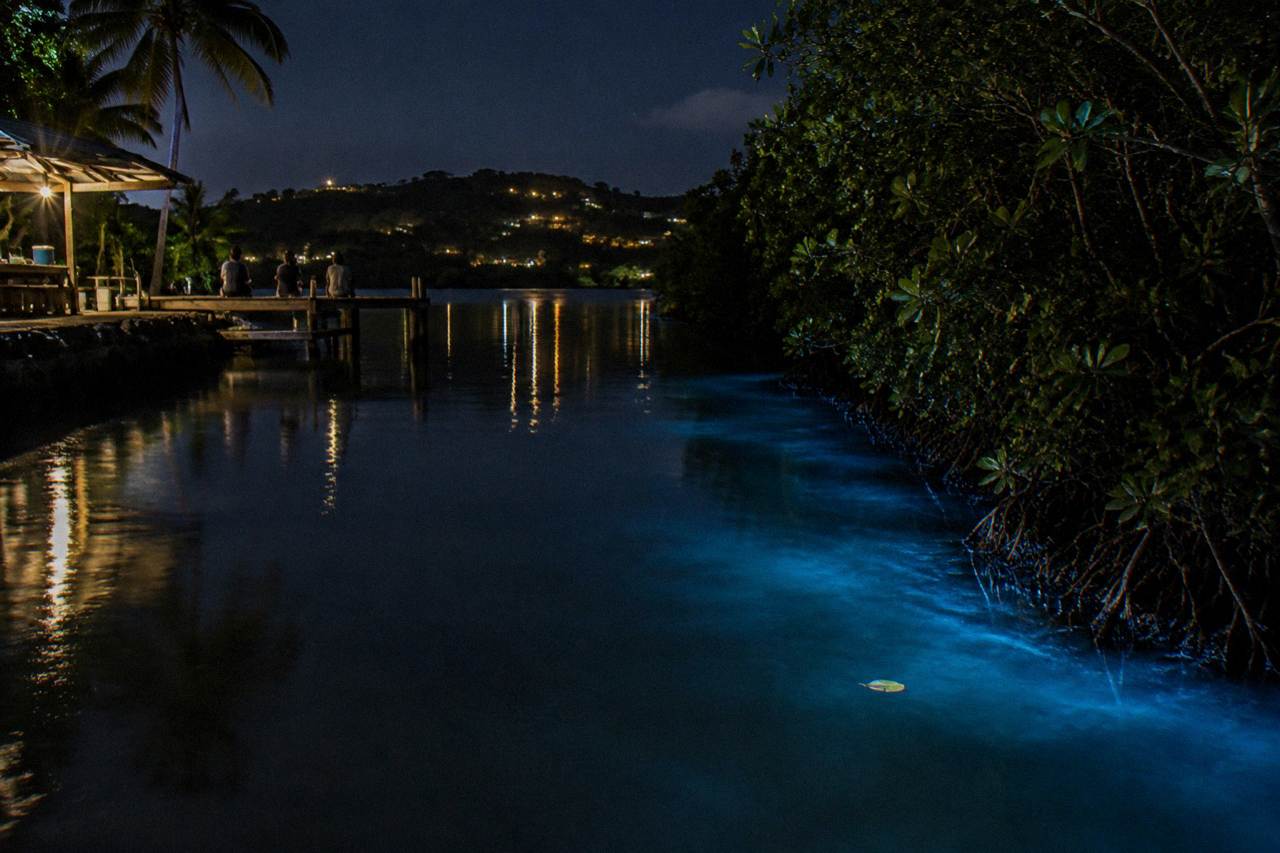
The glow comes from Pyrodinium bahamense, a dinoflagellate plankton that flashes blue when the water is agitated. Puerto Rico has three of the roughly eleven permanent bioluminescent systems in the world because its bays are shallow, mangrove-lined and narrow-mouthed, so the bloom stays put. Mosquito Bay water residence time is 13.5 to 14.5 days, which lets the concentration build.
A single-celled organism smaller than a grain of sand is responsible for the brightest recorded bioluminescent bay on Earth. Mosquito Bay on Vieques holds a Guinness World Record for brightness, with up to 700,000 dinoflagellates per gallon of water, and every one of those cells flashes blue for a fraction of a second when the water around it is disturbed. A paddle stroke, a fish wake, a raindrop: each one triggers the same chemical reflex.
That organism is called Pyrodinium bahamense, and it is the reason the Vieques Kayaks Bio Bay trip, the Fajardo kayak runs and the La Parguera boat cruises all exist as bookable products. The science explains not just why the water glows but why three small Puerto Rican bays, out of only a handful of permanent bioluminescent systems on the planet, concentrate the effect so well. It also explains what can go wrong: the bloom has collapsed before, and one bay is being actively rebuilt with a multi-million-dollar restoration project right now. Where you base yourself shapes which bay you can actually reach on a dark, calm night, so our guide to lodging near all three bio bays is a sensible next read before you lock in a trip.
What Makes The Water Glow Blue?
The glow is a defense reaction by Pyrodinium bahamense, a bioluminescent plankton that lives in warm, sheltered seawater. When the cell is agitated, a chemical reaction inside it produces a flash of blue light lasting a fraction of a second. The organisms are present year-round in all three Puerto Rico bays, but the visible intensity varies with moonlight, rain and water conditions.
The light comes from a pigment called luciferin and an enzyme called luciferase, the same chemical partnership found in fireflies and deep-sea fish. When something bumps the cell, luciferin oxidizes in a reaction driven by luciferase, and the energy released leaves the cell as a photon of blue light rather than heat. Blue is the color that travels farthest through water, which is why almost every marine bioluminescence on the planet is some shade of it.
Each flash is tiny. What makes a bay look lit from within is sheer numbers, and that is where the chemistry hands over to geography. A single dinoflagellate is invisible; several hundred thousand per gallon turn every kayak wake into a ribbon of light. The agitation trigger matters for visitors too, because a still bay looks like any other dark lagoon until something moves through it. Paddles, hulls and the propeller wash of a boat are all it takes.
There is a common worry worth settling plainly. Pyrodinium bahamense belongs to a genus associated with saxitoxin elsewhere in the world, and shellfish closures in other regions involve relatives of this species. Limited toxin analysis of a Mosquito Bay sample from July 2022 found an extremely low average saxitoxin quota of 0.3 picograms per cell, and the Puerto Rico bay populations are generally treated as non-toxic, with no reported toxicity. The concern in the literature relates to eating contaminated shellfish in other regions, not to touching the water.
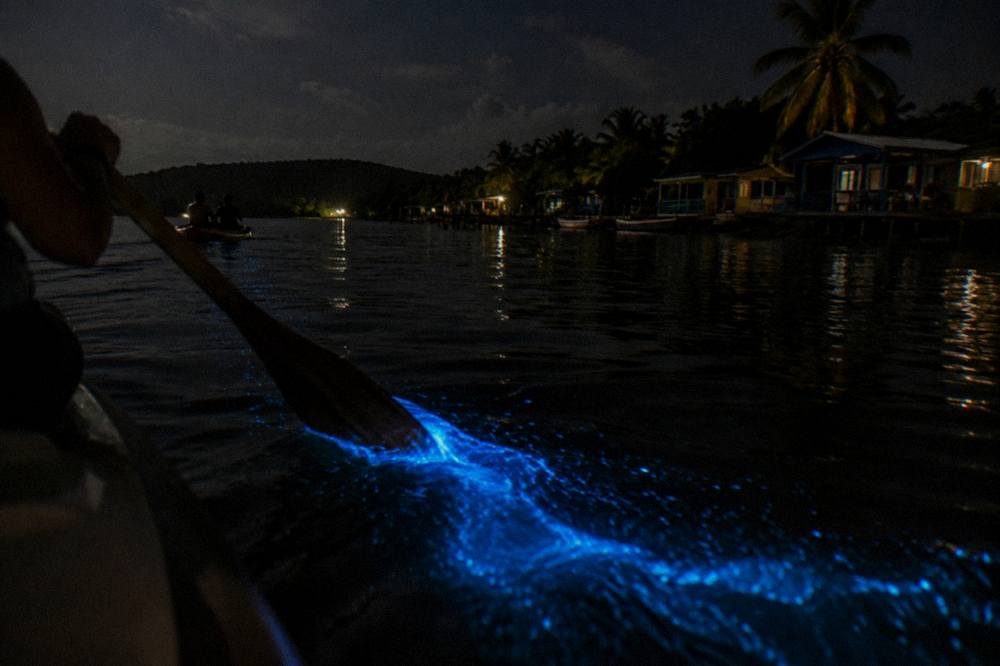
It also helps to know what the glow is not. It is not glowing sand, and no beach in Puerto Rico produces this effect; the phenomenon is entirely water-based. It is not a chemical spill or an added dye, a question that comes up more often than you would expect. And it is not constant: the cells only light when disturbed, so the display follows every movement through the water rather than sitting in the bay like a lamp.
Why Does Puerto Rico Have Three Of The Brightest Bays?
Puerto Rico has three of the roughly eleven permanent bioluminescent systems in the world because its bays have the exact shape the plankton needs: shallow, warm, mangrove-lined and connected to the sea through a narrow, winding mouth. That geometry traps water long enough for the population to build. In Mosquito Bay, water stays about 13.5 to 14.5 days, which is why the bloom grows so dense there.
The residence time is the single most useful number for understanding the whole phenomenon. A bay that flushes quickly with every tide sweeps its dinoflagellates out to sea faster than they can reproduce. Mosquito Bay exchanges its water slowly, over roughly two weeks, so each generation of Pyrodinium bahamense accumulates on top of the last. Faster-flushing bays cannot hold the same concentration, which is why most coasts, even warm ones, never develop a glow worth naming.
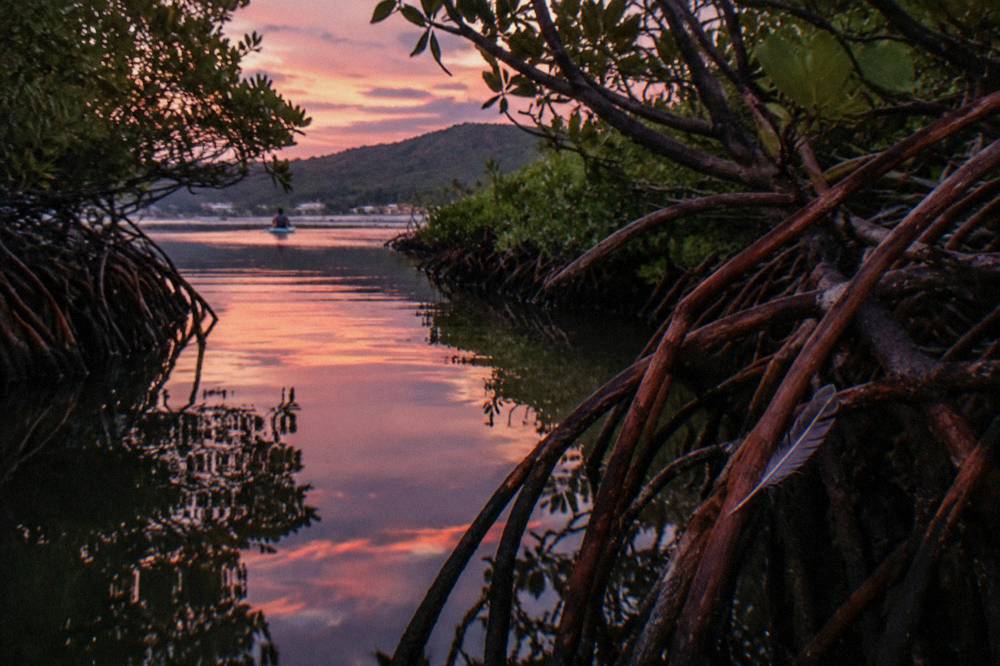
The mangroves do two jobs. Their roots shelter the plankton's life cycle and stabilize the shoreline, and the narrow, meandering channel they frame at each bay mouth slows the exchange of water with the open sea. Laguna Grande in Fajardo is technically a lagoon reached through a narrow mangrove-lined channel inside the Cabezas de San Juan Natural Reserve area, which is the same recipe in a different kitchen. La Parguera in Lajas has its own mangrove fringe and shallow cays, and it is the only one of the three where motorboats are permitted at night and where swimming in the glowing water is generally allowed on most nights, subject to operator safety rules.
The three bays are not interchangeable, and the format you book follows the rules of each one. Mosquito Bay and Laguna Grande are kayak, clear kayak, canoe or electric and pontoon formats only, with no swimming permitted at either, to protect the dinoflagellates. La Parguera is the boat-and-swim bay. The table below shows how the roster's most-booked products map onto that geography.
| Bay | Nearest departure point | Formats on the water | Swimming |
|---|---|---|---|
| Mosquito Bay, Vieques | Esperanza | Kayak, clear kayak, clear canoe, pontoon and electric boat | Not permitted |
| Laguna Grande, Fajardo | Las Croabas | Guided kayak only | Not permitted |
| La Parguera, Lajas | La Parguera docks | Motorboat, swim cruises | Generally permitted on most nights |
If you are weighing the three against each other for a trip, the full breakdown lives in the guide to the best bio bay in Puerto Rico, and the side-by-side comparison of the three bays covers travel time and logistics in more depth.
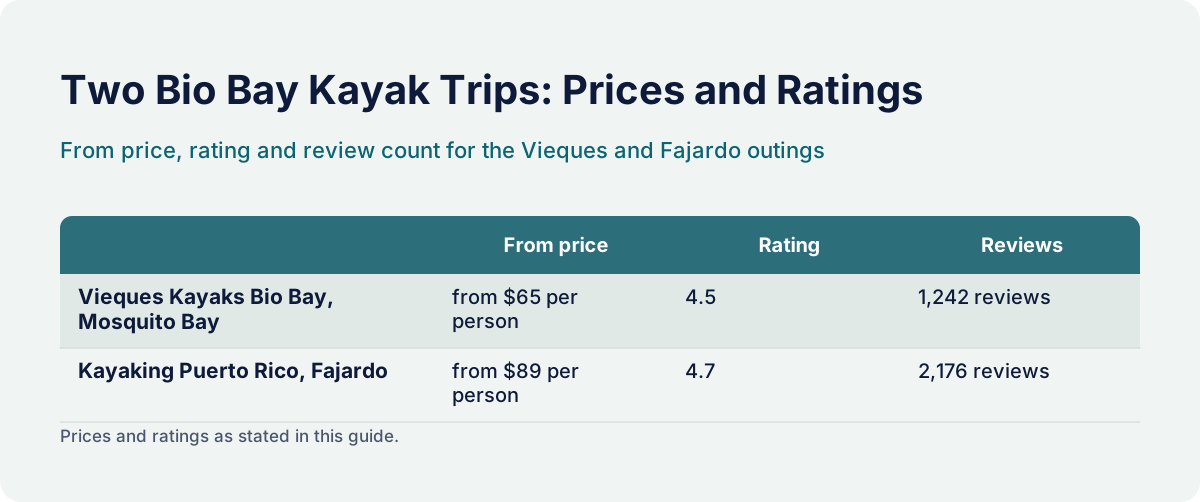
The Vieques Kayaks Bio Bay trip, from $65 per person with a 4.5 rating from 1,242 reviews, is the most-reviewed kayak product on Mosquito Bay on this site, and round trip transport from the meeting point to the bay entrance is on its inclusion list. On the Fajardo side, the Kayaking Puerto Rico outing runs about 2 hours from $89 per person, rated 4.7 from 2,176 reviews, with light snacks, refreshments and eco-friendly insect repellent on the inclusion list. The Mareaito sunset and biobay cruise covers La Parguera by boat, rated 4.8 from 573 reviews, price on the live listing, with a sunset swim at the Caracoles sandbar before the bay; bring your own snorkel gear.
What Threatens The Bioluminescent Plankton?
The bloom has failed twice in Mosquito Bay's recent history, in 2014 and after Hurricane Maria, when visible organisms disappeared for about seven months. The ongoing threats are heavy rain that dilutes and clouds the water, sargassum intrusion, and the loss of the mangroves that hold the bays' shape. A NOAA-funded restoration of about $2.96 million began in December 2024 to rebuild that structure.
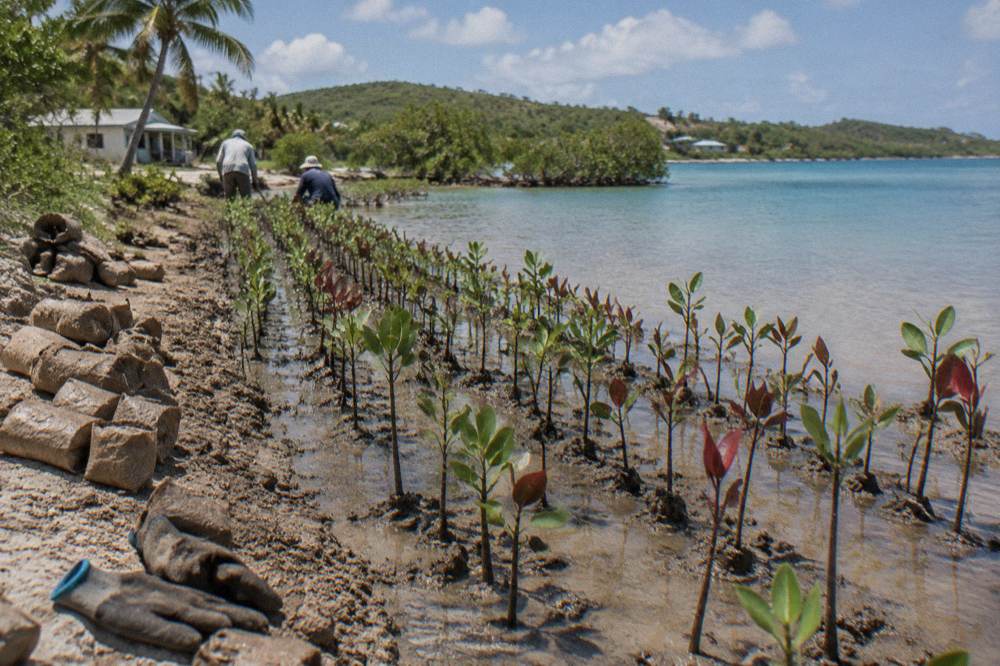
The 2014 blackout at Mosquito Bay is the event that changed the bay's rules. When the glow returned, swimming was banned to protect the recovering population, and the ban stands today. Hurricane Maria was harsher: the storm surge caused almost total mortality of the mangroves at the mouth of Puerto Mosquito, the trees that shield the bloom from washing out to sea. Natural recovery of that forest can take 15 to 30 years, which is why the Vieques Conservation and Historical Trust runs a mangrove nursery and reforestation project rather than waiting.
The restoration work is now substantial. NOAA awarded roughly $2.96 million through its National Coastal Zone Management Program for mangrove, seagrass and coral restoration in the Vieques Bioluminescent Bay Natural Reserve, a project that began in December 2024 with the trust and DRNA. It established a nursery of close to 4,000 plants and deployed 4,000 biodegradable living shoreline bags, and it has achieved an 84 percent mangrove planting success rate. Four mangrove species, red, black, white and button, are being planted to restore the bay entrance and push conditions back toward pre-Maria levels. The trust's own bay page documents the nursery program, and NOAA's project story carries the grant and planting figures.
Sargassum is the newest pressure. In July 2026, sargassum covered about 80 cuerdas of La Parguera bay and DRNA activated its removal protocol, moving a specialized vessel and a long-reach excavator from Fajardo. The 2026 influx to Puerto Rico was projected at a record of roughly 55 million tons, up from 40 million the prior year, and the removal actions touched multiple coastal sites including bio bay areas. The effect on the glow is indirect: mats of seaweed change the water conditions the plankton depends on, and the removal machinery is itself a disturbance.
| Event | When | Effect on the glow |
|---|---|---|
| Mosquito Bay blackout | 2014 | Glow collapsed; the recovery led to the swimming ban |
| Hurricane Maria | After the storm | Near-total mangrove mortality at the bay mouth; visible organisms gone about seven months |
| NOAA restoration begins | December 2024 | Nursery of close to 4,000 plants; 84 percent planting success so far |
| Sargassum at La Parguera | July 2026 | About 80 cuerdas covered; DRNA removal protocol activated |
Rain is the everyday version of the same risk. Heavy rainfall can temporarily reduce dinoflagellate concentrations and cloud the water, lowering the visible glow, which is one reason a dim night is always possible no matter which bay you book. The honest framing, and the one every listing on this site operates under, is that the organisms are present year-round but the visible intensity varies with moon, rain, season and water conditions. No operator can promise a bright night, and any page that does is selling something the bay does not offer.
How Do Scientists Measure The Glow?
The Vieques Conservation and Historical Trust has run weekly plankton counts at Mosquito Bay since 2014, sampling the water and counting Pyrodinium bahamense per gallon. During a June 2026 visit, biologists measured 304,000 organisms per gallon, well below the record ceiling of 700,000 but a strong concentration. Those counts are how both blackouts were caught and tracked.
The counting is simple in principle and disciplined in practice: take a sample, count the cells, repeat every week, and watch the trend. That record is what turned the 2014 blackout and the post-Maria disappearance from anecdotes into documented events with rough durations, and it is why the current restoration has a baseline to measure against. The trust co-manages the reserve with DRNA and also runs water-quality monitoring alongside the plankton counts.
The June 2026 figure is worth reading carefully. A count of 304,000 organisms per gallon is not a dim bay; it is a very dense population measured on one week of one year, against a record association of up to 700,000 per gallon recognized by Guinness in 2006. The number moves with the seasons and the weather, which is exactly why a single weekly reading is never the whole story. A 2024 study of Laguna Grande found the same pattern there: densities fluctuate widely, generally low in late winter and higher in late summer, and hurricanes effectively rake and refresh the lagoon before the population reproduces again.
| Measurement | Figure | What it means |
|---|---|---|
| Guinness record association | Up to 700,000 per gallon | The ceiling associated with Mosquito Bay, recognized 2006 |
| Weekly count, June 2026 | 304,000 per gallon | A strong concentration measured during a site visit |
| Saxitoxin quota, July 2022 sample | 0.3 picograms per cell | Extremely low; the bay populations are treated as non-toxic |
| Water residence time | 13.5 to 14.5 days | The slow exchange that lets the bloom build |
The monitoring also feeds the rules visitors meet on the water. DRNA-licensed operators may not run Mosquito Bay tours the night before, the night of and the night after a full moon, three nights per lunar cycle, because moonlight washes out the display. That restriction is specific to Mosquito Bay, and it is the one moon-phase closure on the books. The Guinness record page carries the brightness association for anyone who wants the primary source.
When Is The Bioluminescent Plankton Brightest?
The plankton is present year-round, but the visible glow is strongest on dark, calm nights: around the new moon, in settled weather, and away from heavy rain. Warmer months from May to October tend to support the densest populations at Laguna Grande, while the drier months from December to April offer the most stable viewing weather. No night is guaranteed.
Moonlight is the biggest single factor you can plan around, because it is predictable months in advance. Around a new moon the sky is dark and the glow has nothing to compete with; around a full moon the same glow is genuinely hard to see. The Mosquito Bay full-moon closure exists for that reason, and at Fajardo one operator leans into it instead: the Puerto Rico Bio Bay Tours full moon kayak is sold as a full moon outing through the mangrove channels, a different product for a bright night rather than a cancelled one.
Weather is the factor you cannot plan around as cleanly. Heavy rain dilutes and clouds the water, and a storm that passed days earlier can still be visible in the glow's intensity. The trade-off across the year is real: warmer months tend to support peak dinoflagellate populations at Laguna Grande, while the drier winter months bring calmer, more reliable conditions on the water. Neither half of the year is the wrong half to visit; they reward different things.
The full moon calendar and the booking window logic are laid out in the moon phase guide for the bio bays, and the seasonal question gets its own long treatment in the piece on the best month for bioluminescence in Puerto Rico.
| Condition | Effect on the visible glow |
|---|---|
| New moon period | Darkest skies; the glow has least competition |
| Full moon period | Glow is harder to see; Mosquito Bay tours do not run three nights per cycle |
| Heavy recent rain | Concentrations can drop and the water can cloud |
| Warm months, May to October | Tend to support denser populations at Laguna Grande |
| Dry months, December to April | Most stable viewing weather |
The practical version of all this: book the dark-sky window, treat the weather as a bonus, and hold the free cancellation. Every listing on this site offers free cancellation up to 24 hours before, so a date chosen for its moon phase costs nothing to move if a storm rolls in.
How Do You See The Glow Without Harming It?
You see the glow through a licensed tour, in the format each bay allows: kayak at Laguna Grande, kayak or boat at Mosquito Bay, boat and swim at La Parguera. You protect it by using reef-safe repellent applied well before the water, keeping lights and noise down, and not touching or removing anything from the bay. The rules exist because the plankton is the attraction.
The visitor rules are short and they apply at all three bays. Use eco-friendly insect repellent, and prefer creams or balms over sprays, applied at least 30 minutes before the tour so it does not wash off into the water. Avoid flashlights, phone screens and any unnecessary light, because bright light destroys the night vision the display depends on. Keep noise down, and do not touch or remove anything from the water. The official guidance from Discover Puerto Rico states these rules for all three bays.
The formats follow from the protection. At Laguna Grande the experience is strictly kayak, and swimming is prohibited to protect the bay's fragile dinoflagellates. At Mosquito Bay the same no-swimming rule applies, with the added full-moon closure. La Parguera is the exception, the only bay where motorboats run at night and where swimming in the glowing water is generally permitted on most nights, with flotation required and no touching of the organisms, per the operators' own safety rules.
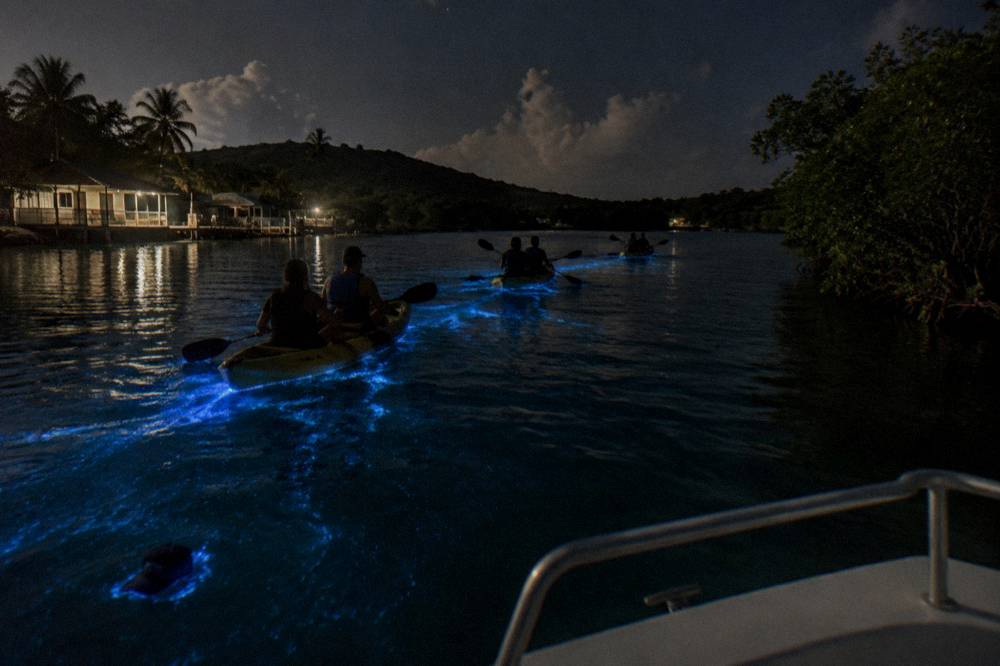
The roster gives you a real choice of format within those rules. The Alikei Adventures clear kayak tour at Mosquito Bay, from $60 per person and rated 4.8 from 491 reviews, puts you in a transparent hull so the water below you is part of the view, and the van ride to the bay is on its inclusion list. The Isla Nena pontoon boat tour covers the same bay without paddling, from $85 per person, rated 4.4 from 262 reviews, on a 24 foot pontoon for about 40 minutes on the water. At Laguna Grande the Yokahu kayak trip from $67 per person, rated 4.6 from 1,821 reviews, is the value end of the Fajardo options.
For a fuller comparison of what each format feels like on the water, the guide to bioluminescent bay kayak tours and the piece on clear kayak bio bay tours break down the differences, and the question of whether you can visit without a tour at all is answered separately.
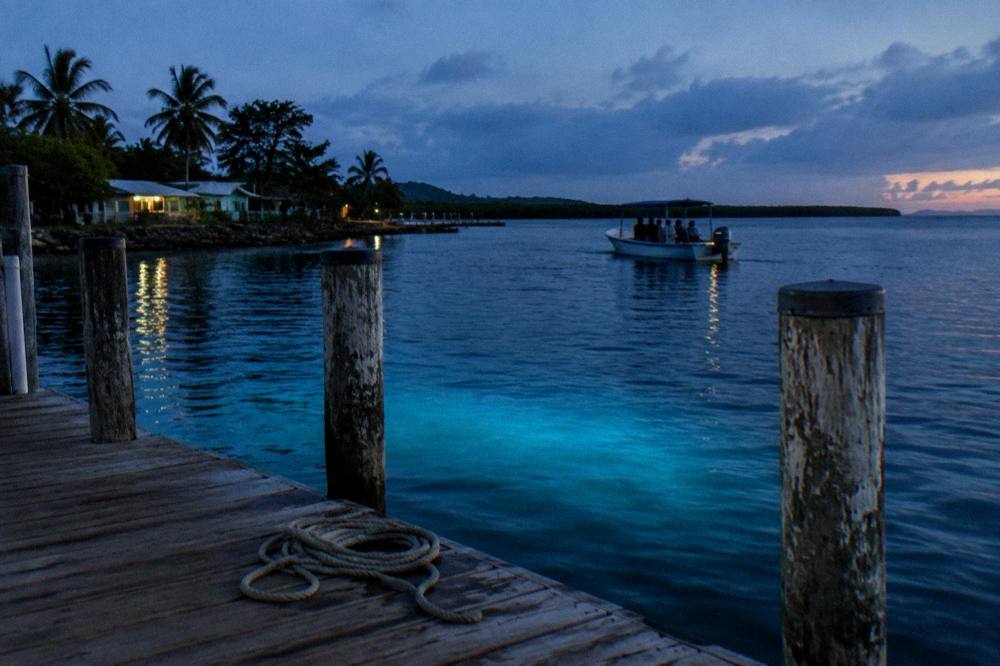
What you wear matters less than what you put on your skin, but both are covered in the what to wear guide. One thing no packing list fixes: cameras and standard phones struggle to capture the glow the eye can see, so plan to look rather than to shoot. The guides who run these bays nightly are the ones enforcing the light discipline, and the listings reflect it, with some operators stating outright that flashlights are not allowed on the water.
Is The Glow At Risk Of Disappearing Again?
The bloom has recovered from both documented collapses, and the current picture is a bay under active management rather than a bay in decline. Weekly counts continue, the mangrove restoration is succeeding at 84 percent planting survival, and no widespread closures or brightness collapses have been reported beyond localized sargassum and rain effects. The risks that remain are structural: storms, sargassum and the slow pace of mangrove recovery.
The honest answer to whether the glow is still happening is yes, with the standing caveat that intensity varies. All three bays are described as operating normally in the current official guidance, and the monitoring that would catch a collapse is running. What changed after Maria is the response: instead of waiting 15 to 30 years for the mangroves to return on their own, the reserve is being actively rebuilt, with a nursery, a living shoreline and a planting program measured by survival rate.
The deeper protection is the one visitors participate in without noticing. Every kayak group that stays on the water rather than in it, every repellent applied before boarding, every screen dimmed on the paddle out, is part of the same management the scientists are doing with counting slides and seedlings. The tours are the monitoring program's neighbors, and the busiest nights at Mosquito Bay are the same nights the trust's data describes.
If the science has settled one question, it is this: the glow is not a fragile accident but a system, and systems can be kept. The record at Mosquito Bay, the counts at Laguna Grande and the swim rules at La Parguera all point the same way, toward a phenomenon that survives because people decided it was worth protecting. Planning a trip around it is easier with the Bioluminescent Bay Tours Puerto Rico comparison pages, which sort the 24 bookable listings by bay, format and price.
Common Questions About The Bioluminescent Glow
What plankton makes the bioluminescent bays glow?
The dinoflagellate Pyrodinium bahamense. It is a single-celled bioluminescent plankton that flashes blue when the water around it is agitated, using a luciferin and luciferase reaction. Mosquito Bay has held up to 700,000 of these cells per gallon of water.
Is the bioluminescent plankton harmful to humans?
No reported harm from water exposure. Limited toxin analysis of a July 2022 Mosquito Bay sample found an extremely low average saxitoxin quota of 0.3 picograms per cell, and the Puerto Rico bay populations are generally treated as non-toxic. Saxitoxin concerns in the literature relate to eating contaminated shellfish in other regions.
Why does Puerto Rico have so many bioluminescent bays?
The bays are shallow, warm, mangrove-lined and connected to the sea through narrow mouths, so water exchanges slowly and the plankton accumulates. Mosquito Bay water stays about 13.5 to 14.5 days. Puerto Rico holds three of the roughly eleven permanent bioluminescent systems in the world.
Can the glow disappear completely?
It has twice at Mosquito Bay, in 2014 and after Hurricane Maria, when visible organisms were gone for about seven months. Both collapses were documented by weekly counts, and both recovered. A NOAA-funded restoration of about $2.96 million has been rebuilding the mangroves since December 2024.
Does the glow happen every night of the year?
The organisms are present year-round, but visible intensity varies with moonlight, rain and water conditions. Mosquito Bay tours do not run the night before, the night of and the night after a full moon. A dim night is possible at any bay, and no operator can promise brightness.
Why is swimming not allowed at some bio bays?
Swimming is not permitted at Mosquito Bay or Laguna Grande to protect the dinoflagellates, a rule that dates from the 2014 Mosquito Bay blackout recovery. La Parguera is the only one of the three where swimming in the glowing water is generally permitted on most nights, under operators' own safety rules.