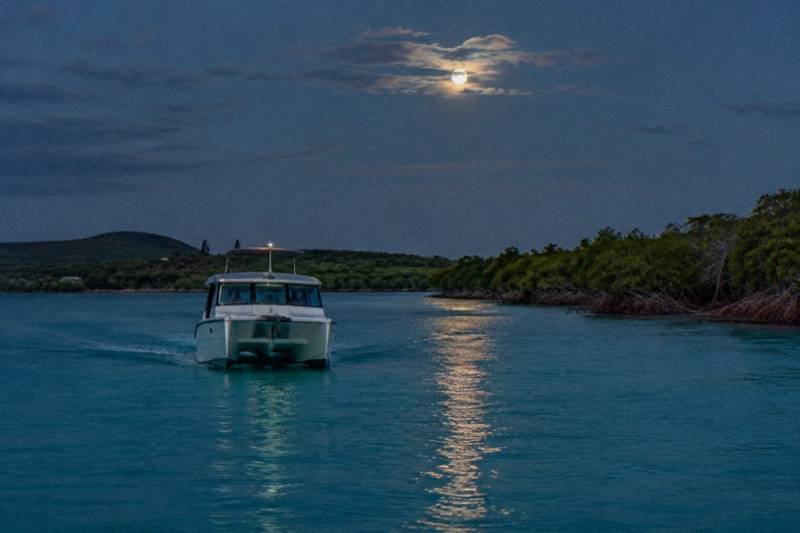
How To Photograph The Bioluminescent Bay
Phones and most cameras cannot capture the glow the way your eyes see it. Flash and bright lights are banned because they ruin night vision and dim the bioluminescent display. This guide explains what you can realistically shoot, which tours give you the best chance, and how to set up your gear for silhouettes, stars, and the glowing wake without promising results.
Short answer
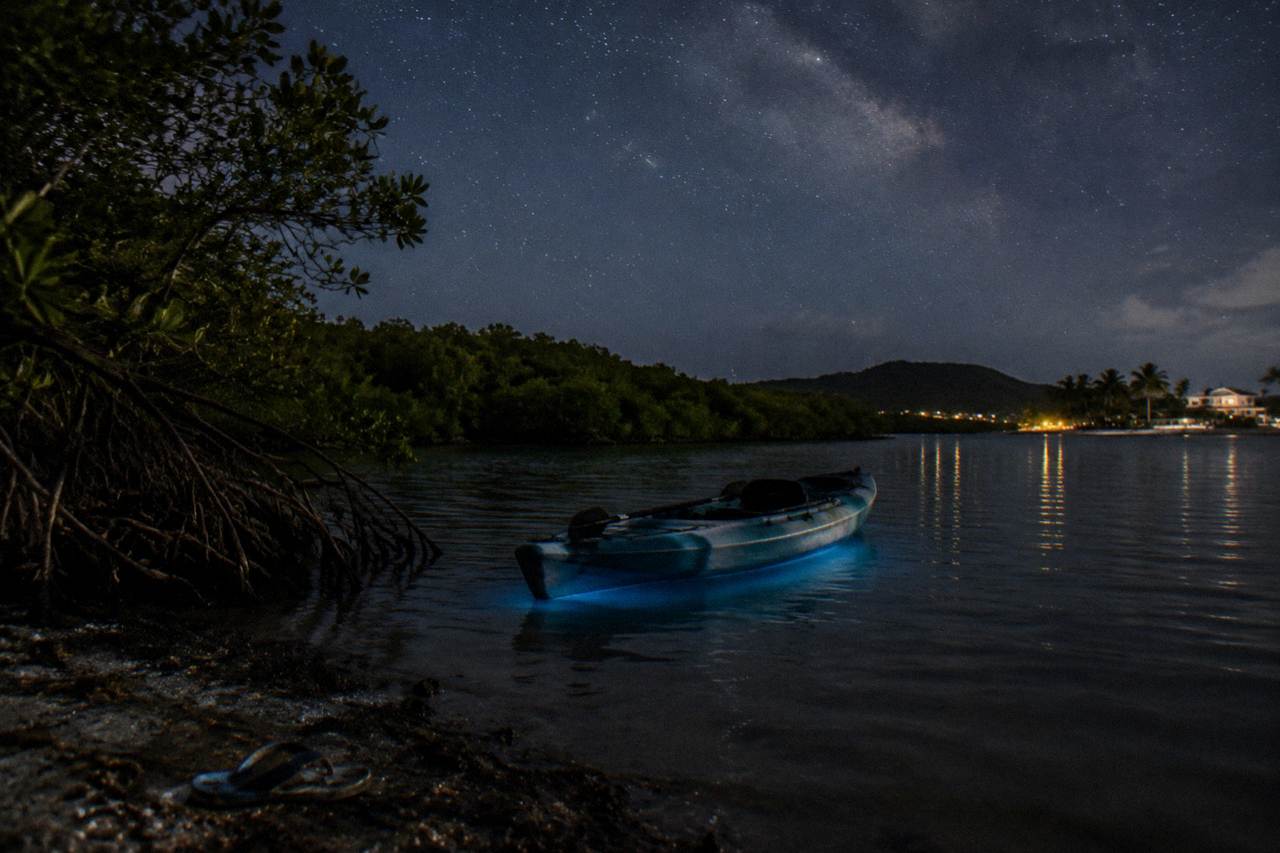
Phones and most cameras cannot capture the bioluminescent glow as the eye sees it. Flashes, flashlights, and bright screens are banned because they kill night vision and the glow itself. With a tripod and manual settings you can get silhouettes, star trails, and the paddle wake. No tour guarantees a photographable glow, but stable platforms and dark nights give you the best shot.
The first thing to understand about photographing a bioluminescent bay is that the glow your eyes see and the glow a sensor records are two different things. The dinoflagellate Pyrodinium bahamense emits a brief, faint blue flash when the water is disturbed. Your dark-adapted eyes pick it up easily after about twenty minutes without light. A phone camera, by contrast, sees only a black frame unless you hold it perfectly still for several seconds, and even then the result is usually a dim smear. That gap is the whole challenge of Bioluminescent Bay Tours Puerto Rico photography, and it is why so many people come home with a memory instead of a photo. The good news is that you can still come away with striking images: star fields above the mangroves, silhouettes of kayaks against the horizon, and the glowing comet tail of a paddle wake. You just need to know what to expect and which gear and tours give you a real chance.
What Can A Phone Camera Capture In The Bioluminescent Bay?
A phone camera cannot record the bioluminescent glow as your eye sees it. On a dark night with a tripod and a manual camera app that holds the shutter open for 10 to 30 seconds, you may capture a faint blue haze around a paddle stroke or a dim outline of a kayak. Without a tripod, every shot will be blurry or black. Most people leave with a memory, not a phone photo.
The physics works against you. Bioluminescence is a low-light, high-contrast scene: a point of glowing water against near-total darkness. Phone sensors are designed for daylight and well-lit interiors. Their night modes work by taking multiple short exposures and stacking them, which blurs any moving light. The dinoflagellates flash for less than a tenth of a second, too fast for the stacking algorithm to catch. The result is a muddy smear or nothing at all.
A few phones with larger sensors and manual control can do slightly better. If you have a phone that shoots RAW and lets you lock focus to infinity, you can try a 15- to 30-second exposure on a small tripod. Aim the phone at the water where a paddle is about to dip, and trigger the shutter just as the blade enters. You may get a faint blue arc. But even under ideal conditions, the image will look nothing like what your eyes saw. The best phone shots from a bio bay are usually of the stars above the mangroves, not the glow below.
For that reason, many operators actively discourage phones on the water. Bright screens ruin night vision for everyone in the group, and a dropped phone is lost in the lagoon. If you bring a phone, keep it in a waterproof pouch with the screen locked, and only take it out during a designated stop. The kayak tours that run through the narrow Fajardo channel often pause in the open lagoon where you can try a shot without paddling.
Why Is Flash And Bright Light Banned On Bio Bay Tours?
Flash, flashlights, and phone screens are banned because they immediately destroy the dark adaptation of every person in the group, and the bright light can temporarily suppress the bioluminescent reaction itself. The dinoflagellates glow in response to mechanical agitation, not light, but a sudden bright light shocks the eye and makes the faint glow invisible for several minutes. For the best viewing and any chance of a photograph, all artificial light must stay off.
The rule is universal across all three bays. Guides will tell you to keep your phone in your pocket and your headlamp off. If a tour provides red-filtered lights, use only those, and only when absolutely necessary. A single camera flash from one guest can ruin the experience for twenty others. It also makes photography pointless: the flash overpowers the bioluminescence and leaves you with a washed-out snapshot of a black lagoon.
From a photographic standpoint, flash is useless anyway. The glow is a light source, not a reflective surface. A flash illuminates the water and the kayak but kills the bioluminescence in the frame. The only light you want is the glow itself and the stars. If you are serious about shooting, choose a tour that explicitly allows tripods and long exposures, and let your eyes adjust for at least twenty minutes before you touch the shutter.
Some operators, like the one behind the Kayaking Puerto Rico Bio Bay Kayak Tour, brief guests thoroughly on light discipline before launch. The mangrove channel that leads to Laguna Grande is pitch black, and the guides use only a dim red light at the rear. That total darkness is what makes the lagoon so bright to the eye, and it is the only condition under which a camera has any chance.
What Camera Gear Can Actually Capture The Glow?
A camera with a large sensor, a fast wide-aperture lens, and a tripod can record the bioluminescent wake, star trails, and silhouettes. No consumer camera can capture the glow as a bright, detailed scene the way your eyes see it. The key is manual control: manual focus to infinity, a wide aperture, a high ISO, and a shutter speed of 10 to 30 seconds.
The most common mistake is trying to freeze the glow. Bioluminescence is a moving, faint light. A fast shutter speed will capture nothing. You need to let the sensor gather light over time. That means a tripod is mandatory. Even the steadiest hands cannot hold a camera still for 10 seconds. A small travel tripod that fits in a kayak hatch or a clamp that attaches to the kayak rim works. Some pontoon boat tours, like the Isla Nena electric boat on Mosquito Bay, offer a more stable platform than a kayak, which helps with long exposures.
Lens choice matters more than the camera body. A fast prime lens with an aperture of f/1.4 or f/1.8 can gather four to eight times as much light as a standard zoom. A wide-angle lens, around 14 mm to 24 mm on a full-frame sensor, lets you include the sky, the mangroves, and the water in one frame. Manual focus is essential because autofocus hunts in the dark. Set focus to infinity during daylight and tape the focus ring so it does not move.
Here is a general guide to the settings that work for most bioluminescence photography. These are starting points, not guarantees. Every night is different, and you will need to adjust based on the moon, the water conditions, and how bright the glow is.
| Setting | Recommendation | Notes |
|---|---|---|
| Aperture | f/1.4 to f/2.8 | Faster is better. A wide aperture gathers more light but reduces depth of field. |
| ISO | High (start at a mid-range and increase as needed) | Higher ISO brightens the image but adds noise. Adjust based on the scene. |
| Shutter Speed | 10 to 30 seconds | Longer exposures capture more glow but turn stars into trails. |
| Focus | Manual, set to infinity | Autofocus fails in the dark. Pre-focus during daylight or on a distant light. |
| White Balance | Cooler setting (preserve blue tones) | The glow is blue. A cooler white balance keeps the natural color. |
| File Format | RAW | RAW files retain far more shadow detail than JPEGs. |
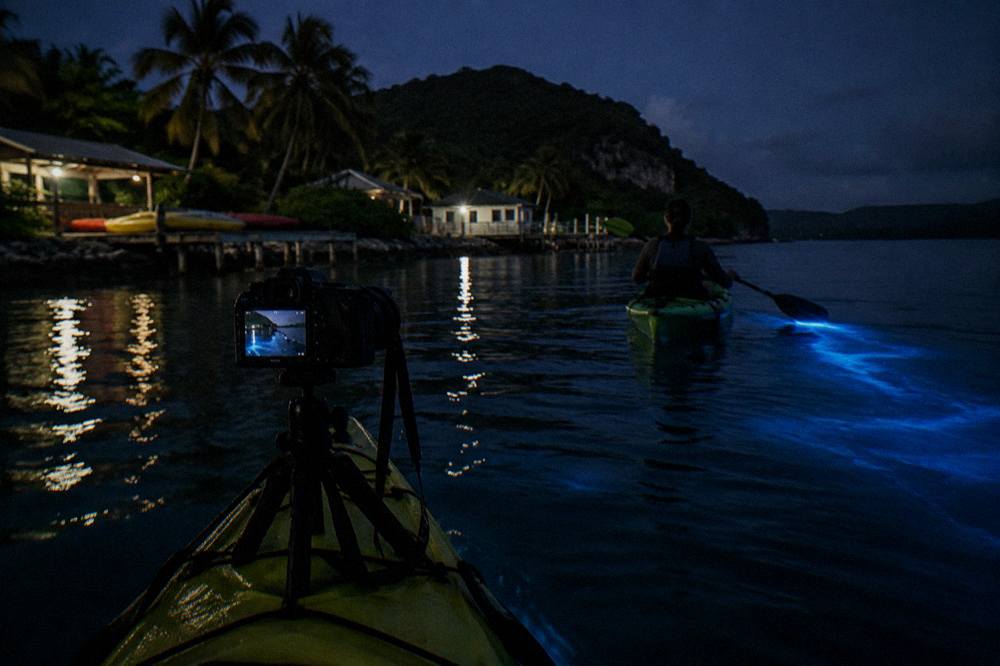
The tours in the selection above give you three different platforms: a tandem kayak through the mangrove channel to Laguna Grande, a stable pontoon boat on Mosquito Bay, and a sunset cruise at La Parguera that includes a swim stop. Each one offers a different set of photographic possibilities. The pontoon boat is the most stable, which helps with long exposures, while the kayak gets you closest to the water where the glow is brightest to the eye.
Which Bio Bay Tours Give You The Best Chance To Photograph?
Tours with stable platforms, longer time on the water, and minimal artificial light give you the best chance. A pontoon boat or clear kayak offers more stability than a standard sit-on-top kayak. Tours that run on moonless nights are ideal. The Isla Nena pontoon boat on Mosquito Bay, the Mareaito Charters sunset cruise at La Parguera, and the Kayaking Puerto Rico tandem kayak at Laguna Grande are three solid options.
Stability is the single most important factor after darkness. In a kayak, every paddle stroke moves the boat, and any long exposure will show motion blur. A pontoon boat, like the one Isla Nena runs on Mosquito Bay, sits flat on the water and drifts slowly. You can set up a tripod on the deck and shoot 20- or 30-second exposures without the frame jumping. The trade-off is that you are higher above the water, so the glow looks less intense from that angle than it does from a kayak at water level.
Clear kayaks, such as the ones Alikei Adventures uses on Mosquito Bay, put you right at the surface while giving you a view through the hull. Photographically, the clear hull does not help much because the glow is outside the boat, but the low angle and the ability to shoot over the side without a paddle in your hands can work well. The clear kayak tours on Vieques are small-group outings that often pause for photography.
The La Parguera sunset and bio bay cruise from Mareaito Charters is a different experience altogether. You get a sunset swim at a sandbar before the boat heads into the bioluminescent bay. The light is still fading when you arrive, which gives you a chance to set up your camera in twilight. Then, when the boat stops and the guide invites you into the water, you can shoot the glow from the deck while others swim. The motorboat is stable, and the two-hour tour gives you plenty of time to experiment.
For many photographers, the Laguna Grande kayak trip remains the most accessible option. It departs from Las Croabas, about an hour from San Juan, and the paddle through the mangrove channel is an experience in itself. The Kayaking Puerto Rico tour runs with a maximum of 30 travelers, and the guides know the best spots to pause for photos. If you bring a small tripod that straps to the kayak, you can get a clean shot of the wake behind your partner's paddle.
Tips For Shooting Silhouettes, Stars, And The Bioluminescent Wake
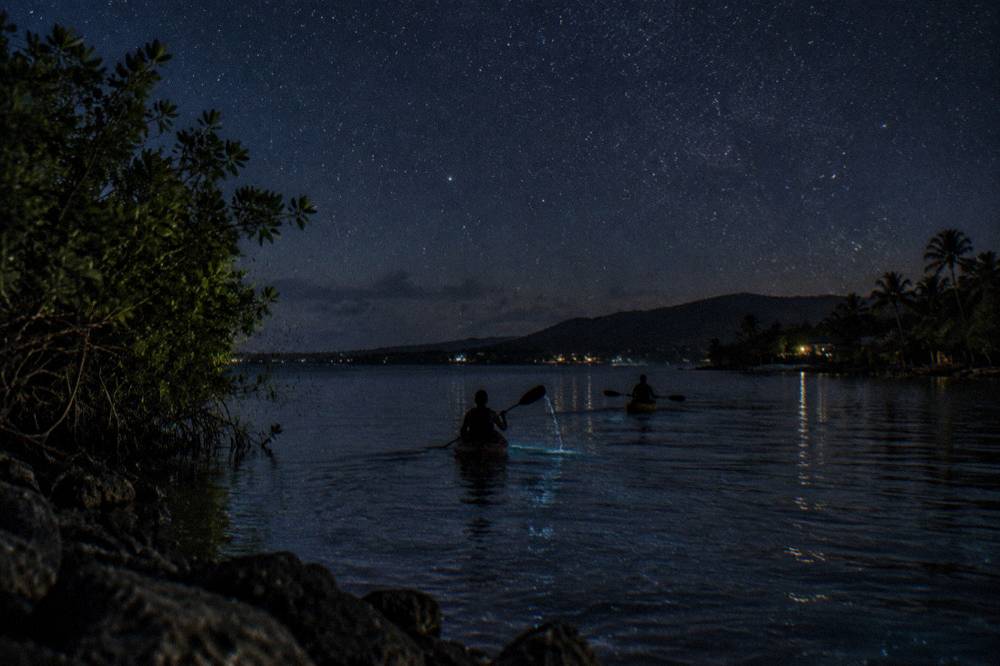
Silhouettes are the most reliable photograph you can get on a bio bay tour. Position a kayak or a person between your camera and the brightest part of the sky, expose for the sky, and let the subject go black. For star trails, use a 20- to 30-second exposure with a wide lens pointed away from the moon. For the wake, have a partner paddle steadily while you shoot a long exposure from behind, capturing the glowing trail.
A silhouette shot works because it does not rely on the camera recording the glow. You are using the contrast between the dark subject and the slightly brighter sky. On a moonless night, the sky over the lagoon is not completely black; there is ambient starlight and sometimes a faint horizon glow from distant towns. Set your exposure for the sky, and the kayak or your partner will render as a sharp black shape. This is the one shot that a phone can sometimes pull off if you brace it against the kayak and use a night mode with a 5- to 10-second exposure.
Star trail shots require a tripod and a remote shutter release or a timed shutter. Point the camera at a patch of sky away from the moon, focus manually on a bright star, and shoot a series of 30-second exposures. You can stack them later in software to create long trails. If the tour pauses in the lagoon, you can include the mangrove treeline at the bottom of the frame for scale. The combination of stars above and a faint blue glow on the water makes for a unique image.
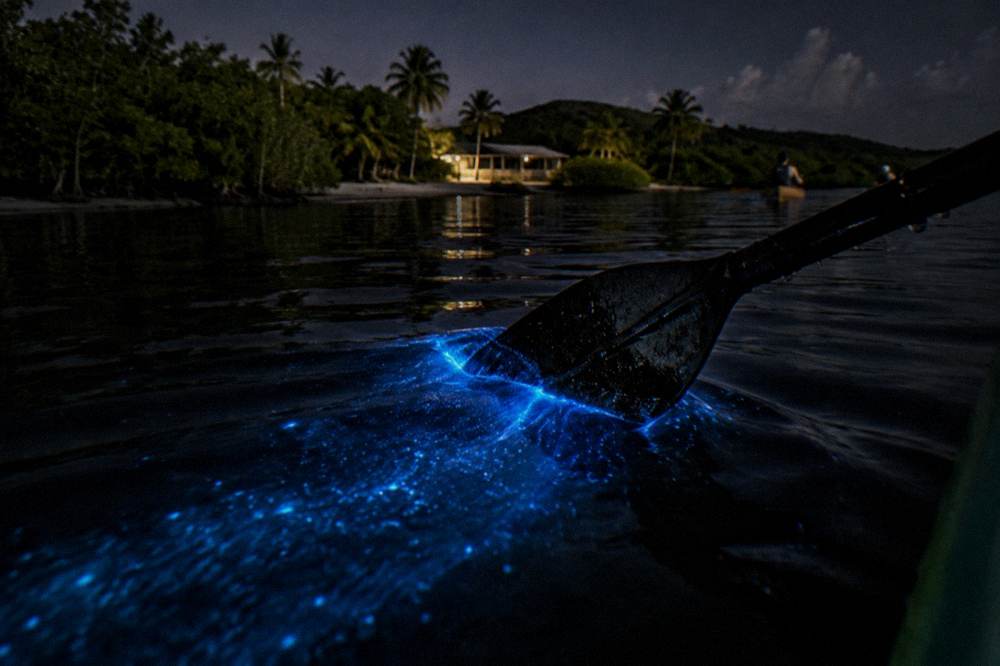
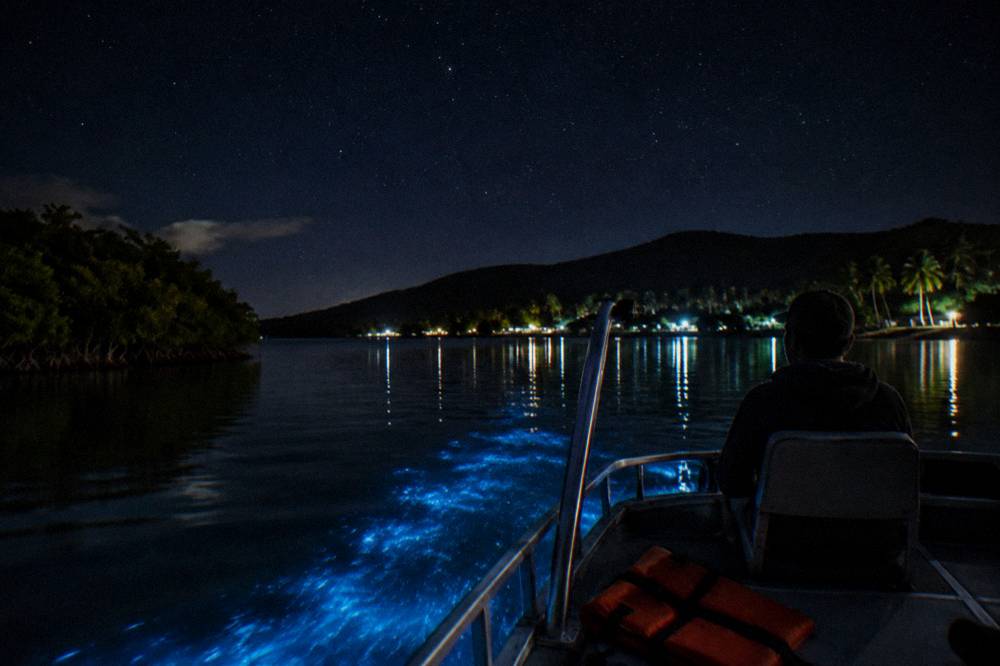
The paddle wake is the one shot that directly captures the bioluminescence. Have your partner paddle steadily while you sit behind them with the camera on a tripod or a clamp. Use the longest exposure you can manage without the boat motion blurring the frame, usually 10 to 15 seconds in a kayak. The paddle blade will leave a comet-like trail of blue light. On a pontoon boat, you can shoot the wake behind the boat itself, which is even brighter because the hull disturbs more water.
The Isla Nena pontoon boat on Mosquito Bay is particularly good for wake shots because the boat moves slowly and the wake is wide. The electric motor is quiet and does not throw spray, so your lens stays dry. With a tripod on the deck, you can shoot the glowing water churned up by the hull for several minutes at a time.
What To Expect When You Try To Photograph The Bay
Expect to come home with one or two usable frames, not a gallery. The glow is fainter to a camera than to your eye, and every tour imposes constraints: no flash, no bright lights, limited time, and a moving platform. The best approach is to treat photography as a bonus, not the main goal. Enjoy the experience with your eyes first, and set up the camera only when the guide gives you a clear window.
The most common disappointment is the gap between what people remember and what the camera records. Your eyes, fully dark-adapted, see a bright blue burst every time the paddle hits the water. The camera, even with a fast lens, records a faint blue smudge. That is normal. The human eye is far more sensitive to low light than any consumer sensor. The photos you see online that show brilliant blue lagoons are almost always composite images or heavily processed long exposures stacked from multiple frames.
Weather and moon phase matter enormously. A full moon washes out the glow and makes the sky too bright for star shots. Heavy rain clouds the water and reduces the dinoflagellate concentration. The best nights are moonless, with clear skies and calm water. You can check the moon phase before you book, and many operators will reschedule you if the conditions are poor. The moon phase guide on this site gives a month-by-month breakdown.
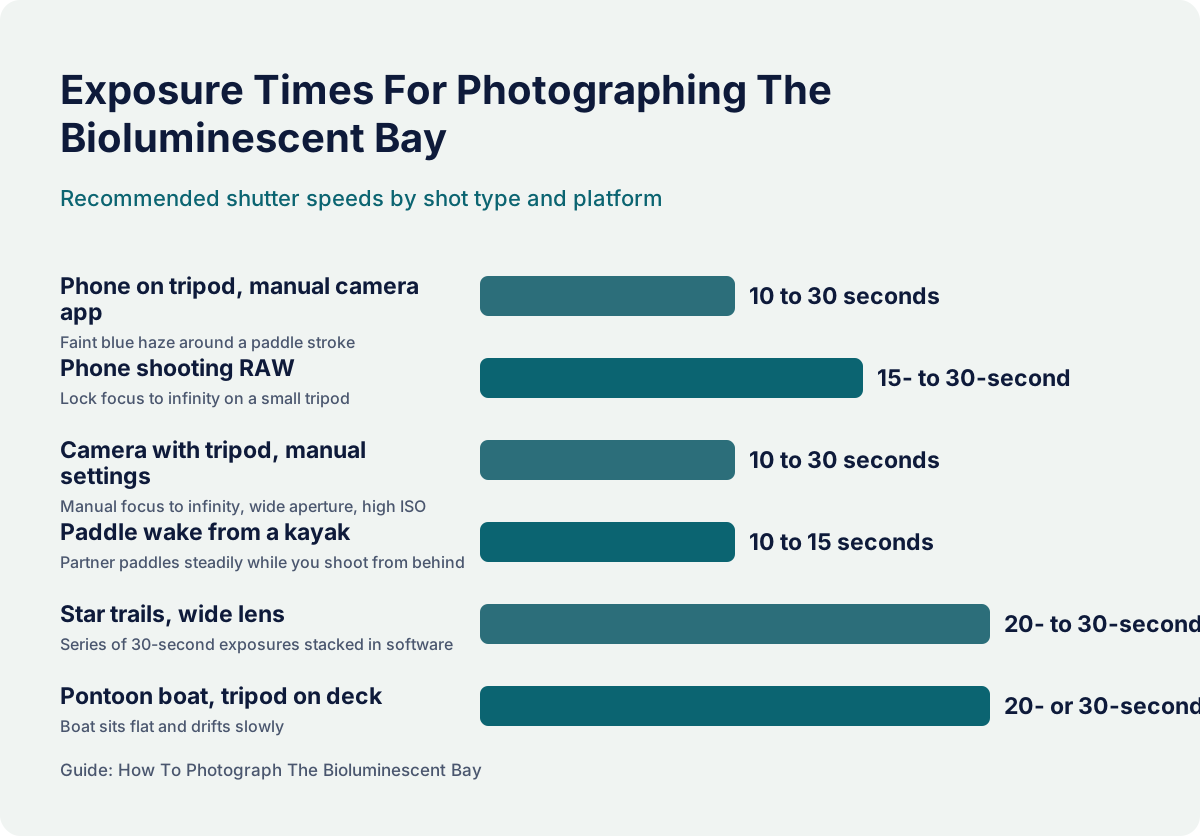
The infographic below summarizes what you can realistically expect from different gear types. A phone will struggle to capture anything beyond a silhouette. A point-and-shoot with manual controls can get a faint wake. A DSLR or mirrorless camera with a fast lens and a tripod can produce a striking image of the wake, stars, and silhouettes, but even then the glow will look dimmer than it did to your eyes.
The Mareaito Charters sunset cruise at La Parguera gives you a rare chance to shoot the glow from the water itself (see How Rare Is The Glow). Because swimming is permitted in La Parguera on most nights, you can take a waterproof camera or a phone in a housing into the water and shoot the glow as you move your arms. The effect is magical to the eye but still faint to the sensor. A GoPro in a waterproof housing, set to a long-exposure night mode, can sometimes capture a blue swirl around a swimmer, but the results vary widely.
How To Prepare Your Gear For A Bio Bay Tour
Pack a small tripod that can fit in a kayak or strap to a rail, a fast prime lens, a remote shutter release or a cable release, and a waterproof bag for everything. Charge your batteries fully because long exposures drain them quickly. Set your focus to infinity during daylight and tape the focus ring so it does not move. Bring a red headlamp instead of a white one, and keep all lights off until you are back on shore.
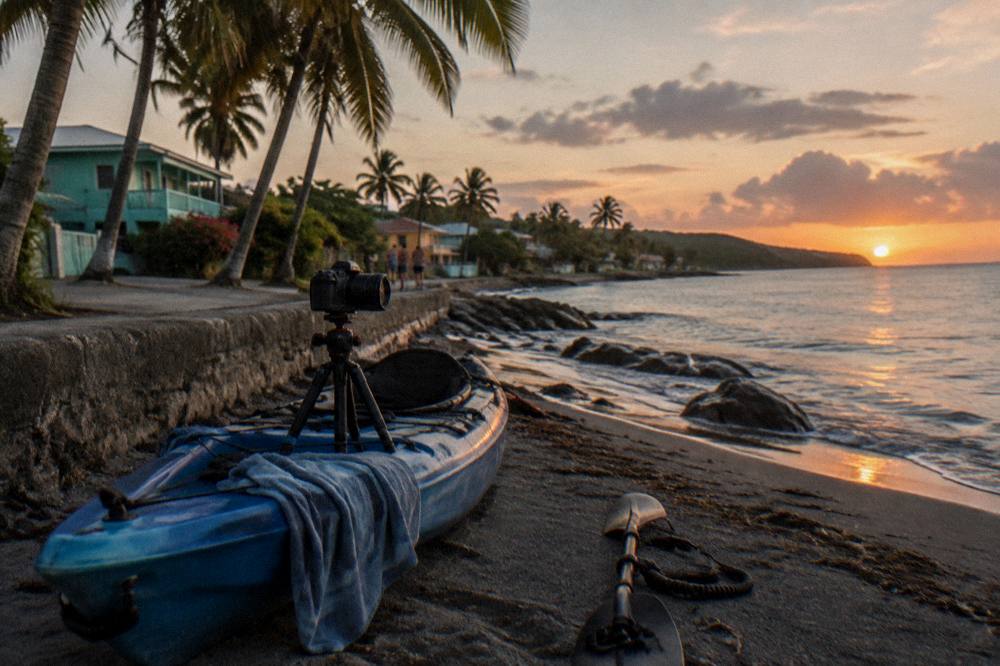
A kayak hatch is small and wet. A full-size tripod will not fit and will get in the way. A tabletop tripod like the Manfrotto Pixi or a GorillaPod with a ball head works well. You can set it on the kayak deck between your legs or clamp it to the rim. If you are on a pontoon boat, a standard travel tripod is fine. In either case, bring a dry bag for the camera when you are not shooting. Salt water and electronics do not mix.
Memory cards fill up fast when you are shooting long exposures and RAW files. Bring at least two high-capacity cards, and format them before the tour. A remote shutter release, even a simple wired one, lets you trigger the shutter without touching the camera and causing shake. If your camera has a built-in intervalometer, set it to take a series of 30-second exposures so you can stack them later.
The table below lists a few tours that are known for giving guests a stable platform and enough time to set up a shot. These are not the only options, but they are the ones that consistently get mentioned by photographers who come back with usable images.
| Tour | Format | Stability | Time on Water | Notes |
|---|---|---|---|---|
| Kayaking Puerto Rico Bio Bay Kayak Tour (Fajardo) | Tandem kayak | Moderate; paddle motion causes shake | About 2 hours | The mangrove channel is pitch dark; guides pause in the lagoon. |
| Isla Nena Pontoon Boat Tour (Mosquito Bay) | 24-foot pontoon boat | High; stable deck for a tripod | About 40 minutes on the bay | Electric motor, quiet, no spray. Small group of up to 9. |
| Mareaito Charters Sunset & Bio Bay Cruise (La Parguera) | Motorboat | High; stable deck | About 2 hours total | Sunset swim stop first; swimming in the bay allowed. |
| Alikei Adventures Clear Kayak (Mosquito Bay) | Clear kayak | Moderate; lower angle to water | About 1 hour 30 minutes | Small group, up to 12. Clear hull gives a unique view. |
The three bays each present different conditions for photography. The table below summarizes the key differences that affect your shot.
| Bay | Platform Options | Stability | Light Conditions | Swimming Allowed | Best For |
|---|---|---|---|---|---|
| Laguna Grande (Fajardo) | Tandem kayak | Moderate; paddle motion | Very dark mangrove channel, open lagoon | No | Silhouettes, wake shots from water level |
| Mosquito Bay (Vieques) | Kayak, clear kayak, pontoon boat | Moderate to high | Dark, Guinness-record brightness | No | Star trails, wake from stable pontoon |
| La Parguera (Lajas) | Motorboat | High | Dark, with sunset light early in tour | Yes (most nights) | Deck shots, underwater wake, sunset silhouettes |
The Kayaking Puerto Rico tour is the featured trip on this site because it combines a fair price, a high review count, and a route through the mangrove channel that is completely dark. The guides are experienced with photographers and will tell you when to put the paddle down and pick up the camera. Book it for a moonless night if you can, and you will have the best possible conditions at Laguna Grande.
The three tours in this final selection cover the three bays and the three most common formats: kayak, pontoon boat, and motorboat with swimming. Each one gives you a different photographic opportunity. The pontoon boat is the most stable, the kayak gets you closest to the glow, and the La Parguera cruise lets you shoot from the deck and from the water.
Common Questions About Bioluminescent Bay Photography
Can you photograph the bioluminescent bay with a phone?
A phone cannot capture the glow the way your eye sees it. With a tripod and a manual camera app that allows a 10- to 30-second exposure, you may get a faint blue haze around a paddle stroke. Without a tripod, every shot will be blurry or black. The best phone shots from a bio bay are usually silhouettes of kayaks against the sky.
Why can't I use flash to photograph the bioluminescence?
Flash is banned on all bio bay tours because it destroys the dark adaptation of every person in the group and can temporarily suppress the visible glow. From a photographic standpoint, flash is useless because the glow is a light source, not a reflective surface. A flash illuminates the water and the kayak but kills the bioluminescence in the frame.
What camera settings work for bioluminescence photography?
Manual focus set to infinity, a wide aperture of f/1.4 to f/2.8, a high ISO, and a shutter speed of 10 to 30 seconds on a tripod are the general starting points. Shoot in RAW format and set white balance to a cooler setting to preserve the natural blue color. Adjust settings based on the moon and water conditions.
Which tour is best for photographing the bioluminescent bay?
A stable platform like the Isla Nena pontoon boat on Mosquito Bay gives you the best chance because you can set up a tripod and shoot long exposures without motion blur. The Kayaking Puerto Rico tandem kayak at Laguna Grande gets you closest to the water, and the Mareaito Charters sunset cruise at La Parguera lets you shoot from the deck and from the water while swimming.
Do I need a special permit to photograph the bio bay?
No special permit is required for personal photography. Commercial shoots and drones are restricted in the natural reserves, but a tourist with a camera and a tripod is welcome on any tour that allows it. Always check with your operator beforehand to confirm that tripods and camera bags are permitted.
What is the best moon phase for bioluminescence photography?
A moonless night gives the darkest sky and the most visible glow, which is ideal for photography. A full moon washes out the glow and makes the sky too bright for star shots. The nights immediately before and after a new moon are the best, and many operators will reschedule you if the conditions are poor.